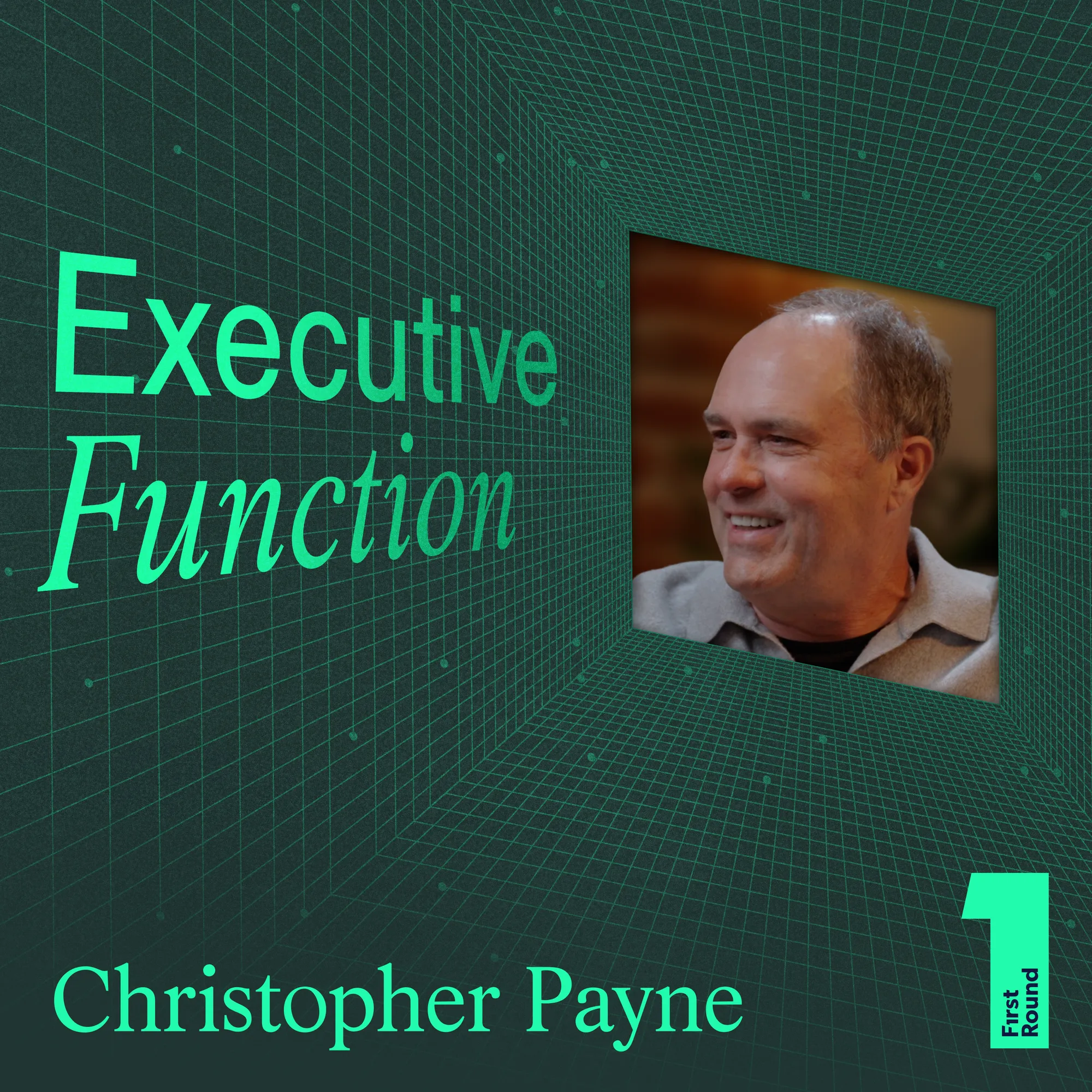
In this latest episode of Executive Function, Brett sits down with Christopher Payne, who spent a decade as President and COO at DoorDash, helping scale the company from roughly 70 employees to the dominant food delivery platform in the US. Before DoorDash, Christopher held senior operating roles at Amazon and eBay, where he led a sweeping overhaul of marketplace search. In this conversation, he unpacks what it actually takes to run an atoms-based business versus a software company, shares his "plate spinning" framework for allocating executive attention across a complex org, and makes the case for top-down goal setting over the bottom-up alternative.
In today's episode, we discuss:
- How prior industry experience can be a liability when you're trying to reinvent the market
- How executives can practically focus their attention to stay close to product details
- What charisma actually looks like in executives—and why it's a staple trait to have
- The business case for setting ambitious goals top-down, not bottom-up
References:
- Amazon: https://www.amazon.com/
- Anthropic: https://www.anthropic.com/
- Cheesecake Factory: https://www.thecheesecakefactory.com/
- Cursor: https://cursor.com/
- Dartmouth College: https://home.dartmouth.edu/
- David Risher: https://www.linkedin.com/in/jdavidrisher
- DoorDash: https://www.doordash.com/
- eBay: https://www.ebay.com/
- Granola: https://www.granola.ai/
- Hulu: https://www.hulu.com/
- Jason Kilar: https://www.linkedin.com/in/jasonkilar
- Jeff Bezos: https://x.com/JeffBezos
- Lyft: https://www.lyft.com/
- Microsoft: https://www.microsoft.com/
- Tinder: https://tinder.com/
- Tony Xu: https://www.linkedin.com/in/xutony
- Travis Kalanick: https://www.linkedin.com/in/traviskalanick
- Uber: https://www.uber.com/
- University of Oregon: https://www.uoregon.edu/
- Wharton School: https://www.wharton.upenn.edu/
Where to find Christopher Payne:
- LinkedIn: https://www.linkedin.com/in/christopherpayne
- Twitter/X: https://x.com/chrispa
Where to find Brett:
- LinkedIn: https://www.linkedin.com/in/brett-berson-9986094/
- Twitter/X: https://twitter.com/brettberson
Where to find First Round Capital:
- Website: https://firstround.com/
- First Round Review: https://review.firstround.com/
- Twitter/X: https://twitter.com/firstround
- YouTube: https://www.youtube.com/@FirstRoundCapital
- This podcast on all platforms: https://review.firstround.com/podcast
Timestamps:
00:00 Introduction
00:14 Why atoms businesses challenge bits executives
02:35 Hiring executives with a builder mentality
06:52 Great executives never outgrow the details
08:05 How ciabatta bread revealed a core DoorDash issue
10:48 How executives can scale their own impact
14:22 One-size-fits-all management is a myth
19:01 Enduring business lessons from Jeff Bezos
20:56 “I was fired from Tinder after six months”
25:38 Why specializing too early is a leadership trap
27:41 Are competitive cultures essential for success?
31:00 Lessons from Amazon’s hypergrowth
35:20 Why having industry experience can be a liability
38:46 Companies spend too much time on job interviews
40:19 The skills executives need for hypergrowth
43:34 Why AI will likely flatten organizations
45:20 Teaching COO 101: What it takes to be world-class
50:55 Why bottom-up goal setting kills ambition
55:29 How charismatic leaders help teams in tough times
58:23 The number-one sign of high-functioning executive teams
1:02:02 How first-time COOs can increase their chance of success
Brett:
So I wanted to start, what's your take on what is the difference about being an exec when you're running an Adams oriented business versus a Bits oriented business?
Christopher:
I was wondering when I joined DoorDash, which of my experiences were going to be most relevant to DoorDash. It turned out to be Amazon by a mile because of this reason. So at Amazon, that was my first experience working with Adams, to your point. And what are the key differences? One is you really have to understand the finances, like the unit economics. And so Amazon taught me how to look strategically with a finance lens at a business that is honestly a terrible business at first blush, and then you have to make the math work.
Same thing with DoorDash, right? If you launch into geography, you start losing money initially, but as you get more scale, you then can improve the unit economics by lowering the cost of delivery. You can get merchants to pay more because you've got more customers and then you can make the math work.
At Microsoft or other companies, the finance problem is like, I don't know, add up the money if you build the right product. So you have to still build a great product with Adams, but you have to make the math work. And it turns out that my mind works like I like those problems. I like the working on the make the math work. And so with DoorDash, we proved out Palo Alto, we could make money there, we expanded.
For a while, there was a narrative like, "Oh, we're giving away dollars for 90 cents." Absolutely not. You couldn't do that because you would even lose money very, very rapidly too fast for a company didn't have a lot of money. But what you do is you're expanding rapidly and you have to go through the life cycle. So you have to hit six months of volume to get the gross margin positive, and then you have to get to 12 months at a certain volume to get what we call contribution margin profit to flow through the bottom line. Once you figure that out and you know that it works for each of your markets, you can then expand very rapidly, which is what happened with DoorDash. So I tend to like both types of businesses, but I enjoy the complexity of solving the Adams problem.
Brett:
A capable executive that works in Bits can to all be successful running Adams oriented businesses?
Christopher:
Definitely not. Definitely not.
Brett:
What's the difference between someone like you that can play both games versus somebody that it's just not going to work for them?
Christopher:
I always look for people that like to build things. I think you need smarts, obviously, but you can't have somebody that runs businesses that isn't capable of going down to the lowest level of detail. If you've got somebody that runs businesses and then gets bored and then starts building businesses, which is kind of what I did in large companies, you can do it. You can actually go down to the business level, but not everyone's going to be successful in doing that. Tony and I talked about this a lot. Tony, the founder of DoorDash, but how do you know during the interview process? And the truth is you don't. And so you just sort of have to try.
Brett:
What's as good as you've gotten at that question?
Christopher:
Yeah. I often, I ask people these builder type questions. So it's like, "Tell me the problems with X." And so they can always do that. And then it's like, "Tell me how you built that. Go back in your mind to the moment that you were thinking about building that and tell me what you're thinking and how you built that."
I'll often ask people product questions. I take them outside of the business world. I'll say, "Tell me your most frequently used product, your AI. AI might be the thing right now. Oh, I use Granola all the time." "Okay. I make you king for a day, you get to add one feature to Granola. Tell me what that is and why." And you'd be stunned.
Brett:
People are running 10,000 person orgs and they make no sense with their ideas.
Christopher:
Totally. And you're like ... And my theory there is if you can't be empathetic about yourself and knowing you and how you use that thing, you say this is your most frequently used AI product and you can't make a feature for that, come on. And there's no chance you're going to be empathetic for a brand new customer. The Adams question, which you started with, I think that's teachable. I think you can learn.
Brett:
Do you think that in all cases of builder oriented exec operating at mega scale will outperform, or there's absolutely a role for the traditional large company executive?
Christopher:
I think you need both. I think you want the builder in a company because you want the perpetual line of S curves. One of the first things I did at DoorDash, because I had a lot of experience with this is, even DoorDash was very young, I founded the first new S curve at DoorDash, which was the platform business. So I worked at Microsoft, I worked at Amazon. So I was like, "Okay, this is going to be platform and there's going to be more volume eventually through the logistics engine of DoorDash than just the restaurant app."
But as an executive that starts these new S curves, one of the things I've learned is that it's my job to protect those S curves because what's going to happen is even in a small organization like DoorDash and really in a large organization, everybody tries to kill the new thing. They just try to kill it because it's taking resources away from the main thing.
And I always say, if you find yourself in a conversation where it's like, what's more important, the little thing or the main thing, you've lost the battle already. So what I tend to do is I reserve resources for the, I call it 10%, put it on the new S curves, protect those, don't let those in the ... And I say, "You guys can deal with the 90%, but you can't touch the 10." Where it gets tricky is if you need some functionality from the main body in order to do the-
Brett:
Right. It's not totally cleaved off.
Christopher:
It's not totally cleaved off. So you try to cleave it off and loosely coupled to the degree that you can, give it enough oxygen, don't give it the same type of goals, or get the right finance people in the room that are capable of helping you make the math work, find product market fit, and then later you can graduate it.
So if you look at DoorDash, you'll say, "Okay, it's restaurants, it's grocery, it's alcohol, it's retail, it's DoorDash Drive, our platform business." All of these now are multi-billion dollar businesses that are ... And so you have to have that. Now, to your point, it's okay when you have a large organization that supports that to have executives that run those organizations, right? They may not be good at building the next S curve. So you have to build a team that has a mixed skillset to be successful.
Brett:
But do you think for them to be successful, they have to be willing to get in the granular details? Maybe an interesting thing is when one part of what I heard you talk about builders, this ability goes zero to one to get a business off the ground. There's another, there's this mindset of like being in the details of having this sort of finger feel for every part in your org versus an exec sitting on a fiefdom of 10,000 people.
Christopher:
100%. Well, I think in general, if you lose the ability to get into the details of the business, to go back to the, I'll call it the base metal, then you've become irrelevant. I fundamentally believe that's independent. Everyone knows that Christopher would go look at the dashboard every day. And I go down to the ... You'd be stunned by the amount of information I looked at, but it's easy once you know what you're looking for, you just go through and you're looking for anomalies, you're looking for things that are going well, things that are surprises, and then you dig into them. So emails start to fly out.
I think the thing that people get wrong though about details is that you need to be able to go down to the detail, but you must be able to then generalize that and then look at the data to find out whether that detail's interesting or important or not. I'll give you an example. One of the things I like to do when we were building the grocery business is I would order groceries. It turns out grocery's a really hard problem. So we order groceries and invariably something would go wrong.
This is a ciabatta bread problem. My wife didn't get the ciabatta bread that she wanted, and she gets mad at me. And so I would then drive to the store, recreate the order as a Dasher, and then go around the store to figure out why didn't you eat the ciabatta bread. It turns out, this is the detail, right? The detail is there's two sections of bread. There's the normal bread aisle, and then there's the fancy bread aisle, or fancy bread area, and then the ciabatta rolls are in the fancy bread. And what was happening in the amp is we weren't directing them there. So that's a detail.
So now I'm curious. So now I got to go back and run the queries and go, "Hey, is there a higher defect rate in these categories?" Meats that have multiple areas, bacon. Turns out there are. Now I'm really interested, right? So now I start to, "Oh, it's 35% higher, missing and incorrect," or whatever the quality stat is you're looking at. So now I've gone from detail, I've now generalized, I know it's a problem to solve. Now, how do you solve it? And so my theory there would be that unfortunately we needed to get planogram information for every grocery on the planet and direct the Dasher to the right location that we literally had to do that or they weren't going to be able to get the ciabatta bread and everything else that goes along with it.
As an executive, you must retain the ability to go down to that level of detail. If you just stay up here at the 30,000-foot level and you become a manager or just a manager, I think you lose the ability to truly impact.
Brett:
Talk more about that. What is the problem with ... It would be easy to hear what you just explained would be to say you're a very senior operating executive. Someone more "junior" should get in their car, should flip over to dash remote and go do this and go tell you what happened. And so what is the problem with that?
Christopher:
They didn't do it. It's the way I think about it is, yes, I want them to do that. And so my theory is that I can't do everything for sure, but I want to retain the ability to do that in special places where I'm like, "I really would like this to succeed, so I'm going to go deep in this area." And my hope is that I help the team build that business, but I'm also hoping that you're training the next generation to say, "Oh, this is what's meant by being in the details. This is what's meant by solving how to solve a business problem and how to scale the business problem."
So I can't do that in every ... So one of the things I tend to do is like, let's say I'm running a complicated business like DoorDash, right? The metaphor I use is a plate spinning metaphor. Let's say, "Oh, that part of the business is going really well. I'll help them with the goal setting, help them with ... Okay, that's your plan. I'll look at the plan. Great. Okay, spun the plate."
This area over here, this is having trouble getting off the ground. We've tried this a few times. We're not getting product market fit. I'm going to prioritize that this quarter. I freed up enough of my capacity. I'm going to go deep with that team. And one of the things I like to do when I do that is I'll sit down with a team and say, "Okay, I'm going to work this with you as if I'm a team member, not the president and COO of the company. I'll put that hat on if needed, but I am going to be a team member and we're going to work this problem."
And so the ask I have of the team is that they share the sausage making process with me. What doesn't work, what doesn't ... So then I can get involved at a level that's necessary to try to help. Then I can back away from that. That plate is spun and you can go do something else. It's a strategy I've used in my career to scale myself. And so every quarter I might have two or three of those special areas that I'm going deep on with the hope that I can kind of scale myself. And to your question, I'm hoping while I'm doing that and helping that product area succeed, I'm helping train the people on how to take it forward.
Brett:
When you're diving into different parts of the business at that level of detail, what is the benefit when you're back up at altitude?
Christopher:
So you know the business, right? So it's like, let's take the DoorDash example, right? So it's like the initial challenge with DoorDash was like, how do you make these markets profitable? And so to use our working model, you got to go figure out how to make Boston work and how to make Philly work and how to make Palo Alto work.
And it turns out these things are kind of different from one another. And so you then start to say, "Okay, I need a playbook that's common and then that's the 80 and then I need some 20 because it's different." The big cities are different than the suburbs. And so now when you copter up and you're at the high level, you now are like, "Okay, now I understand here's how I'm going to roll out the United States. Here's how I'm going to go from 16 markets to 50 markets to 500 markets to a thousand markets."
You can use the playbooks that you've gleaned by working the problem. I tend to call this crawl, walk, run. That's the crawl phase, right? And then it's like, "Okay, I figured this out. Now we've made it work in one market. Now I'm going to try different flavors and make it work in three markets and then I'm going to go from there." Then you're up at the top level. Now, you know how to allocate capital, you know how to build teams, you know how much personnel you need. You then can build the machine that can go scale that thing across the country. If you just try to run to the end, you won't have the lessons that are necessary to be successful because the problem is not homogenous.
Brett:
How much of it is also the way in which you're able to work with your directs or their directs, that you have a better sense of sort of ground truth and discussion and debate and guiding sort of on a day-to-day basis?
Christopher:
Yeah. I mean, one of the things you realize running a lot of these companies over the course of time is that at the end of the day, it's all about people. You have to have the right people, the right teams. Earlier in my career, I would say that I was sort of like a one size fits all manager. I kind of was like, "Oh, here's how you manage people." And help them set goals and do the one-on-ones and everything like that.
And then as I went through time, I became much, I think better at being a manager in the sense that I realized that each person kind of needed different things. And so I was always trying to figure out, "Okay, I'm coaching this person, what does this person need to be successful?" And obviously you're asking them and you're like, "How can I help you be successful?"
I think earlier in my career, I let go a lot of people because they weren't performing. I read some book, I can't even remember what book it was now and it told me it was like, the first failure is on you. It's your fault as the manager. I was like, "That's kind of cool." And so I really took that to heart. And so I was like, "Okay, that didn't work. Okay, that's on me. I didn't give you the right goals didn't give you the right information. Let's try it a different way."
Holy cow, I was blown away by how much I could ... So that then became a philosophy of like, "Okay, I'm not going to be one size fits all here. It's my job to make this person successful." And I think that one technique that we spent time talking about the data piece of it, I'm often trying to teach that. I'm trying to teach how you go low to the data. I don't like the phrase in the weeds. I always think that's kind of stupid because if you're in the weeds, you're not getting it, right? It's like, no, I want you to be in the data and now I'm going to teach you how to copter up.
And part of it is judgment, you have to have judgment, where to look. I was in Microsoft during the early '90s and I talked about this before we started talking. And at that time, there wasn't a lot of data being used. And so it was all about persuading. I was getting big ideas, product, persuasion. And then I got to Amazon, it was all about data. It's all about running experiments, A/B tests. And I learned a lot during that period of time. I was like, "Oh my God, my instincts are dead wrong often."
And now I would say in the last 10, 15 years, I've been teaching people to not just use data, but to use their judgment to actually like, "Don't overlook the human judgment." I think it's very important in this era of AI. The metaphor I often tell people, I said, "So it's like we're running a store, a grocery store, and there's a spill of milk on aisle seven." I literally have had people who want to run A/B tests to figure out whether it's a more productive use of time to clean up the spill on aisle seven or restock the shelves on aisle four and run some long range study. Well, that's=
Brett:
We got to take care of the milk.
Christopher:
Just clean up aisle seven, just clean it up. You know we should just clean it up, so just go clean it up. So that art and science duality I think is critical. But at the end of the day, if you've got the right people underneath you, you can do anything, you can pivot, you can do whatever. If you don't, it don't matter. You can have the best strategy.
Brett:
And so you don't think if you're star talent, you can work sort of in any environment. The manager doesn't have to coach you in a certain way or you found that the opposite is true, that the way that you work with people really changes what they can do.
Christopher:
Well, first of all, I think I agree with both points. So I think there's stars that can be successful everywhere in any environment, and then there's people that need coaching. And often you'll get people that'll be like, they want to be the ... Everybody wants to get promoted, right? Everyone wants to get promoted. They want to be managers and all this stuff.
And they might be incredibly good at what they do. Sales is the example. Engineering is the example. And sure enough, you promote them and they're not good at that next function. That's a good example where you've got a rockstar that's incredible that you're going to have to help them get to that ... If that's what they want, if they don't want to still be like super coder and eventual, you should make that possible too. But if that's not the path they want, if they want to be a manager, it's like no, you're going to have to go back to school. You're going to have to study this like you did engineering and this is going to be hard and that needs to be helped and taught.
And so if you advance to a level and some people do and you don't get that coaching or mentorship or experience and people are not helpful with you, you can easily run a foul and it's too bad because you were a rockstar.
Brett:
Who were some of the people that did that for you? And what were those moments that they took you aside that had some real impact?
Christopher:
At Amazon, I would say that David Richard was my boss. He's now the head of Lyft and Bezos. We was a very small company back then. And I learned so much from them. So I was in Microsoft coming into Amazon and Microsoft's a very challenging environment, very competitive environment. And when Bill challenges you, you respond with force. You got to be behind your idea and everything.
First day I was at Amazon, Jeff challenged me on something and I was fired back and Jeff was like, "I'll just ask you a question." I was like, "Oh God, I'm in a different environment and I need to learn a different system." Jeff, he always was teaching customer, customer, customer. It was like that was the foundation. I had never been in an environment like he start literally the orientation day. There's much about this on the internet where he had an empty chair. Why does he have an empty chair? Everybody was doing orientation and it's like the empty chair is for the customer. You want to represent the customer in everything you do.
That's an example where I was like, "Oh, okay. I've been thinking of this the wrong way." I had strategy, product, business, all of the ... It's like, no, no, you put it around the customer and then you build the strategy. And once he helped me get that, and then I helped build the video business, I led that, then I helped build the electronics business, which was crazy making stuff up as we were going. I liked that. Without that guidance, mentorship, focus on how to do that, there's zero chance I could have done that.
Brett:
What do you think about yourself has allowed you to be so successful at sort of the top level exec jobs? If you introspect what's going on or outside of maybe what you shared thus far, what's like your working theory of yourself?
Christopher:
Well, first of all, it hadn't all been roses. So I think it's very important to be able to look at things that were failures and label them as such and learn from them. And so it's easy to talk about the DoorDash experience. Yay. But then there was the Tinder experience where it was a disaster. I got fired after six months and I didn't fit there. I should have known that. I ran web search for Microsoft, what became Bing. And it was a great experience on the one hand. I went from zero to a thousand engineers. I got to work on that coolest problem. It's all called AI now, but it's called machine learning back then. But did we fulfill what we wanted to do? No.
I told you before we started about my little startup that I founded right into the teeth of the Great Recession, I ended up having to basically sell the company in an acquihire. Now it was great. I enjoyed my chapter at eBay, but it wasn't the dream that I had. And I think, so to your question, I like to look at things. I was a US history student at Dartmouth, and one of the things you learn quickly by studying history is that the best people learn from their mistakes, and they're not afraid to make those mistakes and learn from those mistakes.
And so I try to do that. I try to always look back and say, "What could I have done differently? How can I own this situation?" Yes, there were externalities like a Great Recession, but what could I have done differently? And I think that's helped me. So that's one thing. And then honestly, putting myself in different chairs, like the one I talked about earlier, that has been the most important, because at some point you go from being like, "Oh, Christopher's the Microsoft technology guy to. Okay, Christopher solved that problem, he worked on that problem, now he worked on that problem." You then start to have a repertoire of, "Oh, I can solve business problems."
It doesn't really matter what the domain. It has to be tech. I mean, I like tech, but other than that, I feel like I can dig in, right? I can go to school on the problem and then I can break to bear all this experience. I'll pull from that, pull from this, and it won't be exact, it won't be right, but we'll go for it.
And then maybe lastly, I'll say, I like to iterate and learn. I call it crawl, walk, run. So if I'm tackling a problem, if I can break it down into sub-parts where I can work on a problem ... DoorDash was great for this because instead of trying to launch everything across the United States all at once, you're like, "No, I'm going to start this project in Phoenix. We'll go see if it works there." And once we get it working there, then we'll figure out how to expand it. And so I think that you can't do that with everything. If you're going to change pricing or do a subscription model, you have to do writ large, but I think that ability to compartmentalize and shrink problems down and then walk and then run, I think has been very helpful to my career.
Brett:
What do you think is the difference between somebody who taps out at the number two spot? They're the VP of finance and they never ... Other than maybe bad luck, they're never capable of being a great CFO. They're a great VP of ops or however they ended up in the path to COO and they just don't have the capability.
Christopher:
It's funny, I decided I don't want to be a CEO. I was a CEO of my little company, but the truth is I watched Tony and I was like, "Holy cow, I don't really like this job that he has. I like my job." And so one of the things for me is like, I've been taught all my life is, you should aspire to keep going all the way, tippy top.
And I realized at DoorDash, this was late that I was like, "You know what? I'm good at being the president and COO. That's what I'm good at. I want to build." So that's where I want to spend my time. I don't want to raise money from investors and all that stuff. That's hard work. That's stuff I don't like to do. Tony's brilliant to add lots of things, including that.
Part of it is like it might be okay to be the best VP of finance on the planet. Do you know what I mean? Now, if you want to go to the next level, a lot of times I think people don't take the risks to get there. I don't think they don't take the path. They don't take the risk. It's like, "What does it take to get there?" Often you might be on the controller side of finance, right? You need to figure out, "I got to go learn the strategic side of finance." Are you willing to take a step back in order to do that?
A lot of people aren't willing to do that. And very few people get the generalizable skills, the generalist skills to be successful. I always coach that early in careers. I'm like, "Don't be afraid. Don't be afraid to go over here."
Brett:
Yeah. What do you mean by generalist skills?
Christopher:
Ideally, when you end up running something, you kind of want to know a little bit about everything. I want to know about marketing, I want to know about product, I want to know about BD, I want to know about eng, and I want to be able to bring it all together in a coherent strategy and a coherent go to market.
The problem is we got specialists, specialist, specialist, special. And you can subspecialize. I was doing that on the finance side. And so that was a little bit of the exercise of like, let's get in a different seat where you're uncomfortable and let's see if you can learn that skill. That pushes you, certainly, your skills. It will then increase where you can go and up in the company. But boy, does it make you a better leader.
Because now if I've run eng and I'm now running DoorDash operations, I'm not overseeing engineering, but guess what? I know a lot about engineering. So I now know how to hopefully align myself with the engineering organization. How can I help you be successful? How can I get you the data you need? And I know all roads lead to engineering, right? That's how you scale.
Brett:
And technology business.
Christopher:
Exactly. And so if you don't know that, if you've never had any experience with it, I think it's very difficult to do that. So we live in an era of specialization, but at some point, the people that have generalist skills, I believe, become more valuable. And that is one of the things that helps you break through to get to the chairs that you're talking about.
Brett:
You sort of said this as a passing comment, but if you go back to sort of Microsoft in the '90s, you talked to a lot of people, it was very competitive internally, battling out of ideas. Do you think there's a lot of environments where that's actually great and that's absolutely the way that a company should be run and people should behave?
Christopher:
Yes and no. So on the one hand, I feel very privileged to have been at Microsoft in the 1990s. So that was like, if you want to know my origin story, that's got to be central to it, right? Brilliant people, big vision, reinventing the world. Love that. I thought that was the only way to work, because that was my only experience, circa 1998. Then I learned that's not the only way to do it. And so I could have easily been a lifer at Microsoft and probably answered this question differently.
Now, I realize, actually, you know what, you don't have to necessarily have as much competition internally. There's other systems, perhaps friendlier systems, perhaps better systems. Although I was at Amazon, which is a tough environment as well. So a little bit of both. And the truth is, I pick from now running a company or a division of DoorDash or whatever, like I'm trying to pick the best of. I want the customer focus of Amazon. I want the marketplace nuance of eBay. I want the technology optimism of Microsoft. It's a best of. There's no one size fits all, but it doesn't have to be an ultra competitive place.
Brett:
How do you end up with not just a watered down culture then?
Christopher:
I think the key from a leadership perspective is to set aggressive objectives, like full stop. Tony and I talked a lot about this, like big, hairy, audacious goals. And I coach this a lot. I'm on three boards now and I coach a lot of founder CEOs and I'm like, "Set ambitious goals." So we were talking to one company and I said, "So it's your best AI feature. This is the best AI feature." I said, "What percentage of ... It's very new. Okay, 5% of people use it today. Okay, great, but they like it. That's great. So we're getting product market fit, right? What's the goal for the next six months or whatever?" "Oh, we're going to increase it by 20%." I'm like, "Oh no, that's not going to work, because in order for this to become mainstream, that would take the rest of our ..."
Brett:
Existence.
Christopher:
Exactly. "So no, what you need to do is set, let's 10x this. Why don't we go from five to ... Then it's 0.5 to 5 and then we'll see how to go beyond that." It was 0.5 actually. And so it's like, okay. And that sounds like hard, but the thing is the team then thinks differently about that.
My contention is they don't all have to be assholes in order to achieve that objective. They can work well together. They can be friendly with one another, but they have to be ambitious and driven and biased for action and get stuff done and aim high. But I don't think you have to be competitive and combative, which is the ... And if I'm over-reading into your question, that's what I'm ... But you have to work hard. You have to work hard, you have to work smart, but you don't have to compete. Yes, you have to be competitive, but you don't have to have a culture where it's dog eat dog, I don't believe.
Brett:
You said that Amazon was very hard, but hard in a different way. What way?
Christopher:
Well, I think part of it was the time that I was there. So it was the dotcom boom and the dotcom bust. And so on the one hand, this is why I think people should work in a hyperscale situation, you are forced to learn. So Amazon was like in '98, '99, 2000, we would go from ... I'll tell you my first week there, I was trying ... Christopher, go build the video business. So there's me and Jason Kilar who ended up running Hulu and we're like, "Okay, we're going to go figure this out." And so we went to the Video Software Dealers Association and not a soul would meet with us, literally not us all. I think Artisan met with us because they felt sorry for us, but no one else would meet with us. This is in March or April of 1998 and Jeff wants us to launch in October.
And so roll forward, October of 1998, we launch Amazon. I'm in every Mahogany boardroom for every movie studio. So I went from can't get a meeting at a dealer association to literally talking about the future of e-commerce to Warner Brothers, Columbia, Sony. And so on the cool thing about that, I had experienced that type of growth at Microsoft, but not that acutely, not that crazy. And so you're forced as a up and coming executive, you got to up your game. And it's not just like, "Hey, give me some tougher goals." It's like, it just happens. It's just like, "Oh God, build the electronics business. Go figure out how to do that." I'm like, "I don't know anything about electronics. Okay, go figure it out." There's no playbook to do it, and the pace is electric.
Jeff just said we're going to launch electronics in July of 1999 and toys at the same time. Why? They're big and they're really different. I swear to God, that was the rationale. And it was cool because it pushed us. Harrison Miller was running toys. I was running electronics. And so the environment that we were in, the goal setting that we were in, the fact that we were making up stuff as we were going, forced a level of crazy. I don't think I've worked that hard and learned that much in a period of time in my life.
Then on the other hand, the boom and the bust. The bust happens as well, which you probably didn't go through, but it was an ugly time. It was the dot-bomb and Amazon.bomb and all that stuff.
Brett:
What's the goodness for you personally of feeling that?
Christopher:
Yeah. I mean, what happens is you learn that these cycles ebb and flow. And once you have perspective on that, then you're a little bit less flustered when they happen to you. Jeff took me for a walk and said, "Christopher, they build you up just to tear you down and the best you can hope for is the comeback story." And I think that's right. I think that was wise words.
I was talking to somebody about a reporter or whatever about DoorDash and the stock had been down a bunch or something like this a few years ago. And he's like, "How do you feel?" I'm like, "I don't care." And he's like, "Oh yeah, you do. I know you do." And I'm like, "No, I don't." I was like, "Because you have to have a long-term perspective. This comes and goes."
But we went through a period of time where it was basically of late, the pandemic sort of changed that where it was like everything was pretty much up and there was a whole generation of people that hadn't gone through the downturn. So invariably haul me out, "Hey Christopher, tell people it's going to be okay. You've been through the dotcom thing."
Brett:
You're the one older.
Christopher:
Tell me about the old person.
Brett:
Wheel them out.
Christopher:
Exactly. Wheel them out. It's going to be fine. Don't worry about it. But you do get perspective that ... And in fact, have you gone through it enough, you begin to realize that the downturns are actually the time where you can gain the most share. If you keep your head about you and you've got resources, you can gain the most share.
Brett:
What do you think the role of experience is?
Christopher:
I think it's a mixture. I think that in starting a new business where you're trailblazing, I think often having experience in that particular industry is a negative. So if you're going to reinvent electronics, you probably don't necessarily want to hand it over to an existing executive from Circuit City or Best Buy. And it's not disparaging on them, it's just saying it's an advantage to be able to go say, "Okay, we're going to reinvent this thing and it's going to be different than the current thing." It's almost an advantage to not know the business.
Now, with that said, there's been many cases in my career where having gone through things, I realize the pitfalls. And so now I can apply that experience. I'll give an example. So when I joined eBay, they said, "Christopher, go fix search." That was my thing. This was 2009. 92% of the sales went through search at that time. So I was like, "Okay, this is a pretty high leverage situation." I set the goal, right? I set the goal and I said, "Well, I want to optimize conversion. So if I get one point of conversion, I get a bunch of money basically for the company." And customers are happy, presumably, because they can find what they're looking for.
Well, we didn't have the technology to do this quite right. And so I could only optimize item level conversion, not item times price. And so I said, "Well, I'm going to go build that system in parallel so I can actually auctions with the complexity." But I knew in the back of my head, I knew in the back of my head that I could drive item growth and not drive sales growth. I knew item times price, but I said, "I'll get away with this for six months and then I'll add in the price component."
Sure enough, six months goes by, bought items is up by some nice amount and sales are basically flat. And the CFO's looking at me like I'm insane, right? So okay, now I get the system online, item times price. Oh, sales go up, but you know what? I didn't think about the trustworthiness of the marketplace.
So what happened is a bunch of the sellers that were good at manipulating the thing, but we're not necessarily the best products, we're getting to the top of the list. Okay. Item times price with a trust constraint, that's it. I went through that for like 12 to 18 months before I got that right. But what did I learn as an executive? This is your experience point. Okay, now I learned, okay, I got to be more thoughtful about goal setting. I've got to think about what can go wrong with the goal and how do I set the goal so it's not too complicated because if there's too many constraints, I won't get anything. But if I don't constrain it to some degree, I won't get the outcome that I want. That's a situation where experience helps me tremendously. So I don't think it's a one size fits all answer. I think it's the problem that you're looking at, whether you want to look at it with fresh eyes or whether experience. And the truth is they both can help.
Brett:
And is it mostly when you're thinking about the different backgrounds? It's just sort of a judgment call. Is it like you're putting together a jazz band and it's very sort of finger feel? Or you have a way of like, "Okay, I need somebody who's done this 20 times in this role. I'm willing to take more risk on an up and comer here. I want somebody with fresh eyes here."
Christopher:
I think a lot of pressure gets put on the recruitment process. I think people think they can figure out in the span of 45 minutes whether the person's going to be great at this or not. In my experience, it's-
Brett:
Very noisy.
Christopher:
It's very noisy. It's a batting average thing. I think people spend too much time thinking that they can engineer that process to be perfect. I much rather, yes, we're going to interview, yes, we're going to look for skills, but then we're going to bring them in and we're going to see whether they succeed or not. And I think where organizations fail is they often then don't, when it's not a fit, they don't move on.
Brett:
Everybody says that. Why is that?
Christopher:
It's very easy to just get complacent, unfortunately. I'll give you an example where it's like, you put somebody in charge of something and check in on week one and they'll be like, "Oh my God, this thing is so messed up. We got to do A, B and C. That sounds freaking great. That makes a lot of sense to me. Let's go get that done." Check back, right? A month later, is A, B, and C done? No. Nope, nope. And they moderate.
What happens is often they can't translate it into the doing, and so people don't fix the problem. And as I alluded to earlier, step one shouldn't be to fire the person. Step one should be, I'm not giving the person enough information or enough guidance or enough help to succeed, and you got to lean into that. And then if it doesn't work, you have to move on. Being in a company that's growing like a DoorDash or an Amazon circa that period of time forces you to get good at that because you're going to fail, right? So you're forced to fix that problem one way or the other.
Brett:
What do you think is the difference between an effective executive at a rapidly scaling company versus an effective executive at running an at scale business if there is a difference in your mind?
Christopher:
Certainly the ability to adapt and change is the tippy top in the hyper growth scenario. I think that I like to teach those. I say the thing you're doing now is guaranteed to not work six months from now, guaranteed. And the problem is a lot of human beings, myself included, they're inertia. You want inertia, right? You don't like change. You're in a situation where if you don't change, you're not going to ...
So I'll give you an example at DoorDash. So we used to launch cities by sending in college students basically into cities. It used to be a fun job, right? I'm going to go launch Miami. We'd send a team in there and they would recruit Dashers and train Dashers and sign up restaurants and do the marketing. It was a fun job. But then Tony wants to launch 3,000 cities. We can't do that.
So six months from now, I need to have a model go to market where I can launch cities and not set foot in that city at all. And we don't know how to do that. And Tony wants to keep going. He wants the current model to keep going. We can't stop. So I now need to do that while I carve out some capacity to build the new model, the new launch model. I need to figure out how to get that right, and then I need to put the pedal to the metal as it were to launch.
You need the adaptability to deal with that pace of change, and it's very difficult. It's like, "Well, this is working, right?" Well, yeah, it's working, but we don't have money. We don't have the money to do that. And this gets back to the goal setting. You're like, "I want to launch with no people and I want it to be better than the model with people." And then you got to put the right people on that to our conversation about people who've got to go figure out that. And DoorDash cracked that. We figured out how to expand economically, remotely, and that allowed us to expand across the country. Everybody calls it the suburb strategy, but it really was an expansion strategy. That's how we did it.
But to connect the dots, if you're an executive that you can be amazingly effective at running at a billion-dollar business and I pull this lever and that lever, but the pace of change there is not necessarily great. That's fine. You're good at that, but you may not be good at dealing in this type of an environment where it's like it's built in. You have to change. It turns out that's what I like. I like it.
Brett:
And you've always liked it?
Christopher:
I always like to learn and every time I've moved in my career, I've been kind of bored.
Brett:
That was the reason you moved.
Christopher:
I get bored. Often the reason I moved. And I felt like being in those environments, there's zero chance that you're going to get bored because you're just like, "I don't know how to do that." I'm forced to learn. And so that works well with my stay interested, stay engaged, stay hungry.
Brett:
Do you agree with the idea that a lot of these AI first companies or Cursor or Anthropic are sort of much more flat orgs, much more empowered ICs, a much higher expectation for everyone regardless of how high up you are in the org? The IC-ness of the job is much more or no, there are all thousands of people and general management is general management and that type of thing?
Christopher:
Well, I think in the world we're living in and about to live in, I think that the ability to get stuff done, I'm blown. I'm just absolutely blown away. I don't know about you, but I did not necessarily think we were going to get to where we are in my lifetime.
Brett:
It also shows the comment you were saying a second ago, which is just we don't understand exponentials. And if technology is on a curve, you check in on a year, a lot changes.
Christopher:
We are. Yeah, somebody was saying Claude Code's been out for like nine months, whatever. I was like, "Really? That's all?" And so I think that that's going to have huge implications for how organizations are run and your ability to manage teams of humans and AIs is going to go through the roof. I do think organizations will likely be flatter in the future. I do think that even higher up executives are going to be capable of doing things, which is just astounding.
But at the end of the day, if you're still managing humans, which you will be, I believe, for a long time to come, those are going to require a lot of the skills. I think the generalist skills of building businesses, understanding customers, I don't think those go away. In fact, I think they get more important.
Brett:
More the value of a generalist goes up for specialists.
Christopher:
Yes. Yes.
Brett:
If you're to go back to Dartmouth where you went to school and you said, "Hey, got to go create a course." And the title of the course is how to be a world-class COO. What's the syllabus and why? Why are those classes on there?
Christopher:
I think I would teach how to build, which I think is the job of a COO because I think ... And so the thing that would be on that syllabus, of course, would be we build something and we probably start with AI first in this world. We build it with agentic AI, but I would teach how to build. I would teach how do you go from zero to one? How do you set goals? How do you scale once you find product market fit? How do you build a viable business? That's what I would teach. And I think if you teach that, then you can be a successful CEO.
The trouble with the COO title is it means so many different things to different people. And each company sort of has a different definition of what it is. For me, I viewed my job as my job is to build the business, and that's what I would try to teach.
Brett:
Do you think most of those things you actually could teach, or you would teach them by telling them to go build something?
Christopher:
I do. I do. In fact, one of the things I enjoyed the most last year is I got to go to the University of Oregon where my son went and I just graduated and I got to help a group of young entrepreneurs who were building phenomenal ideas, like fantastic ambition, but not necessarily they didn't know all you can teach. And some of them still literally follow up with me weekly on here's what I'm doing.
So what are some examples of that? One person's building, it's a marketplace to help people with mental disabilities and they're building a network of, it's using video and stuff like that, and it's going fantastically well. I'm super excited about that. Another person was building a T-shirt marketplace that was basically in real time figuring out how to do that. Another person was literally writing, they were writing books using AI and trying to figure out how to go to market with ... The range was just astonishing.
One of the things I learned from this, I'm curious about ... I taught this class once where I was at Wharton and it was half undergrad and half business school students. And you didn't have to tell me who was who. You know how I could tell which one was which? The innovation level for the undergrads was like off the hook. They were so cool. The ideas were so cool, but the business school students had the polished like, "Yeah, here's the plan, here's the ..." But the ideas had been somehow watered down during that process. And so it's like, I wonder if there's a way to keep this, this ambition, but maybe then figure out how to ...
Brett:
It goes all the way down to growing up. Like you see the creativity and curiosity in a nine-year-old. And it's just beaten out of them year by year.
Christopher:
Totally. So in my fake curriculum, I would hope to keep that enthusiasm and great ideas, but maybe help them figure out.
Brett:
But when you were trying to help the students, what are some of the ways that you actually taught or explained how to build?
Christopher:
Yeah. A lot of times it would be like the one vector would be they didn't understand who the customer was. So who's the customer? Who have you talked to? What problem are you solving? That's where you start on most of these things. Some people had that kind of nailed, but they were going so slow. I was like, "Oh my God, this could take forever." So I teach them how to set goals.
One group, the marketplace I was talking about, I basically told them they had a 10x by December, I think it was. And they're like, "Well, where'd that come from?" I'm like, "I made it up." And so I'm like, "But it seems like a good goal. It seems like a reasonable goal." And then I said, "Well, okay, you kind of laughed at that goal, but let's talk about it for just a second. What would have to happen to get to 10x?" And then they start beginning to work the problem.
So, okay, you got to hire this person. You then got to get ... Okay, your bottleneck would be medical or whatever it was. And so, okay, well, how do we get a hundred of those people? And so, okay, I got to do a BD deal. Okay, great, let's go do that. Did they hit the 10x? They did not. I think they got to 8x or something like that. Again, there you're hoping where you're like, "Okay, now I've taught you you can move way faster than you thought you could." Now, what's your next six months goal and see if they've learned the lesson.
So the good news is once you've seen enough businesses, you can pretty quickly ascertain, "Oh, this person doesn't know who the customer is. This person doesn't know how to run. This person has no technology person and they don't know what they're doing on the tech side of the business. I need to tell them how to do that." So pattern recognition, this is your experience, but it matters a lot.
Brett:
You've talked a little bit about this. I can't imagine how much time you've spent setting goals in your career. A lot.
Christopher:
It has to be a lot. And debating goals and getting into arguments about goals.
Brett:
Yes. What else can you share on the art of goal setting other than one of the most important things, which is most people are probably not ambitious enough? And incredible things happen when you set a really ambitious goal and expect a lot of people, what else are dos and don'ts or things that people get confused about when it goes to goal setting?
Christopher:
Well, one of the things that I do is I tend to be very initially tops down in goal setting. A lot of companies and teams are bottoms up in goal setting, and I found that, that is not a great way to have ambition. So what happens if you say, "Well, tell me what you can do." Everyone goes off and they kind of say, "Well, what about this? Well, that'll go wrong. It'll come back, we can do this."
It's not bad and it's achievable, but the problem is they didn't necessarily think as expansively as I would think they should. So I found the following a much better process. What should that team do? I think they should do X. I make it up. This is where experience comes in to play. I know enough about the area. They moved it this rate last year. I think they can move faster. This thing came online. I'm going to push them to do X.
Now, here's the thing, you got to push them to do X with Y amount of resource. Because if you say do X and X is ambitious, they'll come back and say, "Great, I can do X, but I need 4,000 people to do X. I want X with Y dollars and people." Come back and tell me what your plan is. Now, what'll happen is I will ask them to go work that problem. Instead of having knee-jerk reaction that that's impossible, I want you to go work the problem. Now sometimes they'll come back to me and say, "Christopher, I can't get to X, but I can get to 80% of X. Let me explain Y." That's great.
Brett:
This is one of the big tensions with ambitious goals is you feel like people feel like they're not winning.
Christopher:
This happened in one of the companies I coach and I said, "You should promote that person. You should promote that person and say, that's exactly ..." Because you think they did stellarly and you should take it on yourself. I said, "Oh, I set the goal 10% too high. Sorry about that, but I'm so glad we got to 90%." The best execution in the company, I'm going to reward that with promotions and dollars and whatnot and send a message to the company that it is okay to strive for these ambitious goals even if you fall short. The how you did this really matters.
I've even rewarded teams that got nowhere near the goal, but pivoted, learned, didn't make the same mistakes, but they had the energy and effort to try to get there. They'll figure out how to get the batting average up over the course of time. So the tops down philosophy I think is very important and you'll get much further faster than if you do a bottoms up.
And I talked earlier about the figure out, the nuance of make sure you're going to get what you go or you're going to get directionally what you go. So be sure that that's what you want. Where a lot of companies get it wrong is they can be, the goals can be antagonistic to one another. It's like, "I need to do X and you need to do Y and they don't intersect with one another." And so you want the top level goals to galvanize as much of the company.
Like DoorDash has got DashPass our subscription model. That's super important. So if you're running the grocery business or you're running the restaurant business, you're driving DashPass, right? How are you helping add value to either grow the number of DashPass subscribers or retaining DashPass subscribers? And that unites the teams together. So that's another element of goal setting that I think the bigger your company gets, the more you want to align the teams together, and you're always looking for pockets where you got it wrong.
Brett:
What do you think about the topic of charisma as it relates to executives? Do you think about trying to be charismatic?
Christopher:
No.
Brett:
It's just who you are? You have a way of really engaging someone of leaning forward.
Christopher:
That's what you mean by that? Yes.
Brett:
I think that it's developing followership. It's getting someone excited.
Christopher:
If that's what you mean by charisma, yes. That I view as a job of a leader. The job of a leader is to get people excited about the problem that we're solving or the customer need that we're going to meet. I think that's part and parcel of the thing. There's some dark times. You invest in a lot of companies, right? And it does not go smoothly.
Brett:
Most of the time it doesn't go smooth.
Christopher:
There were periods where DoorDash was running out of money and couldn't raise money in '17 and people were like, "Oh my God." It's that those times you've got to be like, "We're good. We're going to get there."
Brett:
I think there's different models of leadership. One is that we're going to sugarcoat everything. Everything's hunky-dory. The other is that no, people see through that instantly and you lose credibility. Once you lose credibility, you have nothing.
Christopher:
Having gone through these things, I often just point back to these things. Look, lots of people left Amazon, myself included actually, in 2001, Amazon.bomb. That was the end of Amazon. Go back and look at a stock chart, have some fun with that one. And that wasn't the end.
Now, I left for other reasons, but that is a good teachable moment. And there's been lots of those in my career. I'll give you an example. So Uber entered the ... This was back in 2017 or whatever, entered the restaurant delivery space. And some people were like, "Oh my God, Uber, they've got-"
Brett:
Unlimited capital.
Christopher:
Unlimited money.
Brett:
Incredible talent.
Christopher:
They got all the drivers, right?
Brett:
Ambition.
Christopher:
Talent, Travis is going to ... It's over. And so it's in those moments where you got to say, "Come on, this is a harder problem. This is a different problem than rideshare. We're going to be best at this." And some people are not going to believe you. Not going to believe you. I can share examples. I'd be like, many people when I was at Microsoft, we would enter a space and they'd be like, "Oh my God, Microsoft. Microsoft's in the personal finance space." Well, ask Quicken how that went for ... Oh, they won. Oh, okay. Just because you have unlimited money and great people doesn't mean you win.
Brett:
Why is that?
Christopher:
I think you got to solve the problem. And often, when you're in a company, this gets back to the new stuff as well. Often what happens is that just because the team solved this problem doesn't mean you solve this problem. It gets back to the, often you don't put the right people on the problem, you don't put enough resources on the problem.
You can imagine like Tony and I, who was showing up at The Cheesecake Factory selling The Cheesecake Factory? It was Tony and me. We were the little engine that could. We were like, "We're not in rideshare. We're in food delivery." And so they went exclusive with us. Is Travis going to the cheesecake factory? Yeah, no. Not a chance.
And so elevating that in terms of the people you put on the problem, making sure those new S curves get started, get to where you need them to go. Not every company's great at ... In fact, most companies are not great at the hit parade. And so you have a distinct advantage when it is your only business.
Brett:
What else can you say about the dynamic of being an executive in the context of an executive team? And when that's really high functioning, what that looks and feels like?
Christopher:
The number one way you can tell is ask them what team they're on. And if they don't say that team, if they say, "I'm on the eng team," or, "I'm on the marketing team, on the product team," then you've got a dysfunctional team. So you want the leadership team, whatever you call them, M team, executive team or whatever, they need to be a team, right? They need to work problems together. They need to have each other's back. They need to not be political.
I think as I've gotten older, it's become easier for me because I don't want anybody's job. I'm not trying to do this or that. Earlier in my career, I was kind of like a wrecking ball earlier in my career because I wanted to get stuff done. And I realized that was perceived as self-serving, got some good feedback from a leader at Microsoft about that.
And one part of me resisted that because I was like, "My goodness, we're not moving fast enough as an organization." But then I realized that my inability to get the executive team aligned or to help get the executive team aligned was holding me back. And so I ended up realizing that that was holding me back to your earlier point. And so I had to figure out how to work within this executive team in order to thrive in my career and to get the things done.
I think a lot of people don't make that. They don't make that leap. That's a litmus test for you. So next time ask that of somebody. "So what team are you on?" And see if you get a range of answers, but you want that executive team to feel like that's their primary team.
Brett:
Do you generally find it's productive when CEOs want to dive down in and around a functional lead, a VP of this or that, and they go and work on a problem low level? Or do you think it's generally the job of the CEO to work with the executive team, let the executive team express themself on the company, sort of their org underneath?
Christopher:
I do both, obviously. I think the default mode should be, you should work within the structure that you've built, but then you should also reserve the right to go work the problem. I've learned so much by doing that, by the way. Then you go down, you're like, "Okay, this team's working on this problem. That problem has not gone well for the last quarter or whatever." Why? I don't know. Okay, I'm going to go work on that problem.
And then you go down and the cool thing about that is you get to see the next group of leaders, get to see who's good and who's not. And then you also learn a lot about the culture that's developing down in the organization. And obviously, you solve the problem, but I try to coach that a lot to executives to maintain that ability to go to the lowest level of detail.
And Tony, he can do that all the way, all the way down. Bill Gates is like that. I mean, I used to be terrified to go into a meeting with him because you'd be like, "What's he going to ask? I have no idea what he's going to ask." It's going to be literally, you could come in and be talking about, I don't know, the architecture of the search index and the next thing you know, you're off on some search business strategy conversation. His range was astronomical and he was conversant on everything asking ... He'd find your weakness, which is very impressive.
Brett:
Someone, maybe a former version of yourself or a friend of yours is joining a company as the COO of scale-up company. I'm starting on Monday. What in your job is to sort of give them advice, make them increase their chances of success?
Christopher:
You've got to study the business, so you need to understand the business. So it's like somebody built this tool at DoorDash that was just unbelievable. This four hours arrived, it's called Dispatch, and you literally could watch an order happening at real time. And it was the greatest tool ever for this.
Literally, I would pull it, I would order, I'd pull up the tool, a restaurant has confirmed the order, right? And then it's like Dasher assigned the order, right? Dasher drives, you can see Dasher drives to the ... And so in something, we invariably go wrong, there'd be customer support interactions. And one Dasher locked the keys in his car.
And literally, I was watching this unfold. This is during my first week at DoorDash. It was invaluable in understanding what we do. That's the lowest level of detail. And then there was the aggregate detail. And I always coach people to look at data on a daily basis. Don't aggregate it to a month or a quarter or look at it on a daily basis, because you'll learn so much more about what's actually going on in the business.
So I built this report straight away that had all the cities and all the numbers and the quality and stuff like that. And what's cool is it looks like a lot of information, but you're really just like, "Oh, something interesting happened in Boston." It's like, "Oh wait, the marathon was yesterday. Oh my God, the quality just fell through the floor. We didn't handle remapping DoorDash correctly because of the route." Right?
Brett:
And then you have customer churn and on and on and on.
Christopher:
Yeah. But then you're like, "Actually, there are lots of marathons that happen. And then there's parades that happen. So how do we handle that?" And then you go on off and you figure out how to do that. So it's like an insight generator. One of the things I did, I love sorting things. So I sort, you get the worst gross profit orders from yesterday. And I would be like click. You look at that detail and you're like, "Oh my God." And then you look at the customer orders and you realize that this person's creating fraudulent orders. Email to the ... Is this what's going on here? Is there a fraud?
And then the other side is, "Okay my God, this is a great order. We should do more of this." I didn't realize that was happening. The Phoenix team did something or the Seattle team did something, let's take advantage of that and spread it across the country. So understand that. Understand the company and what it does.
I went on a journey because DoorDash was very distributed. So my first week, I was in Orange County visit in LA and then I was in Seattle. I was visiting all the teams trying to get a sense for what was actually happening. The gentleman that ran our local team left in the first three months of my arrival of the company. Kevin, if you're listening, I miss you. Now he came back.
Ironically, he did me a huge favor. So I was like, "Tony, this is the center of the company's go to market." So I basically said, "You're going to have to do these other things. I'm going to go run the local teams for a while." And so it allowed me to actually go and understand the company at a very good level. And it was kind of the heart of the go to-market. So I got to understand what we do. And he did me a huge favor. In hindsight, I was like, "Oh, that actually was great." And then I came back and did the COO job.
So if your person's coming into a startup, it's like don't be afraid to do any job that's necessary because you're in a startup. And the other advice I think I would give is you can't solve all the problems immediately. So pick something, solve it, and then solve the next thing is the other thing. You can't solve it all overnight.
Brett:
Oh, great place to end. Thank you so much.
Christopher:
Thank you. I enjoyed it.
Brett:
This was great. You're very good at this.
Christopher:
Oh, thank you.
Brett:
And you're very charismatic.
Christopher:
Oh, thanks.
Brett:
You really are.
Christopher:
Thank you. I appreciate it.
Brett:
You have a way to be excited and get people excited. At least that's my experience.