
A lot has changed since Arielle Jackson (First Round’s Head of Brand and Product Marketing) wrote her first Review article in 2015 on positioning your startup. For over 10 years, she’s helped hundreds of First Round founders with early positioning, brand identity, launch communications and marketing hiring — and while many of the fundamentals remain, her advice the last couple years has shifted as AI changes how companies do all of these things.
So we brought Jackson back to unpack what positioning looks like in the age of AI, and the unique advantage it gives companies when product differentiators can evaporate overnight. You can’t just ship “AI-powered” on your website (like you could, maybe even a year ago). Positioning and brand are the result of thoughtful choices founders must reinforce and continually update. With that, we’ll pass it to Jackson.
For decades, Silicon Valley operated on the assumption that the best product wins. But now models are shared, infrastructure is abstracted, and products that once required years of engineering work can launch in six days or six hours.
For the last couple of years, founders have been able to get away with simply using AI as their differentiator because slapping “AI” onto an existing category felt like something entirely new: "AI-powered provider credentialing," "AI communications for car dealerships," "AI agents for customs brokers.” The novelty made buyers pay attention. The problem is that "AI-powered X" stops being a position the second there are five credible "AI-powered X" companies. It's even worse when they all use the same gradients, the same sterile screenshots, and the same language that turns nobody off but nobody on either. They all claim to be the most accurate, the fastest, and most definitely enterprise-ready.
These products may not literally be identical, but because their differences aren’t legible, people perceive them as interchangeable. When that happens, people default to what feels safest, or in B2B, what's easiest to justify internally. Your product may actually be different and better, but if the difference isn't clear, it doesn't matter.
Brand can help you stand out, but it isn't a self-sustaining moat you install once and enjoy forever. It's a discipline that requires you to make distinct and coherent choices as the category normalizes and AI — whether it’s in your product, design or copy — pulls you toward sameness. Every time you abdicate a choice or play it safe, you become more interchangeable with every other AI startup in your space. And interchangeability is what kills you, especially when switching costs are near-zero.
If bottled water can do it, so can you.
Bottled water is about as close to a pure commodity as you can get. It’s heavily regulated and functionally interchangeable. There is no meaningful technical advantage. In most cases, the product inside the bottle is indistinguishable from the one next to it. And yet, some of the most distinctive brands in the world have been built in this category.
Take Evian and Liquid Death. Neither claims their water is the “best.” Evian’s point of view is that water isn't a commodity if you trace it back to its source. They position around purity and provenance. Liquid Death stands on the belief that water can be “metal.” They position water as a substitute for soda, energy drinks, or alcohol for people who’d otherwise choose those less hydrating options.
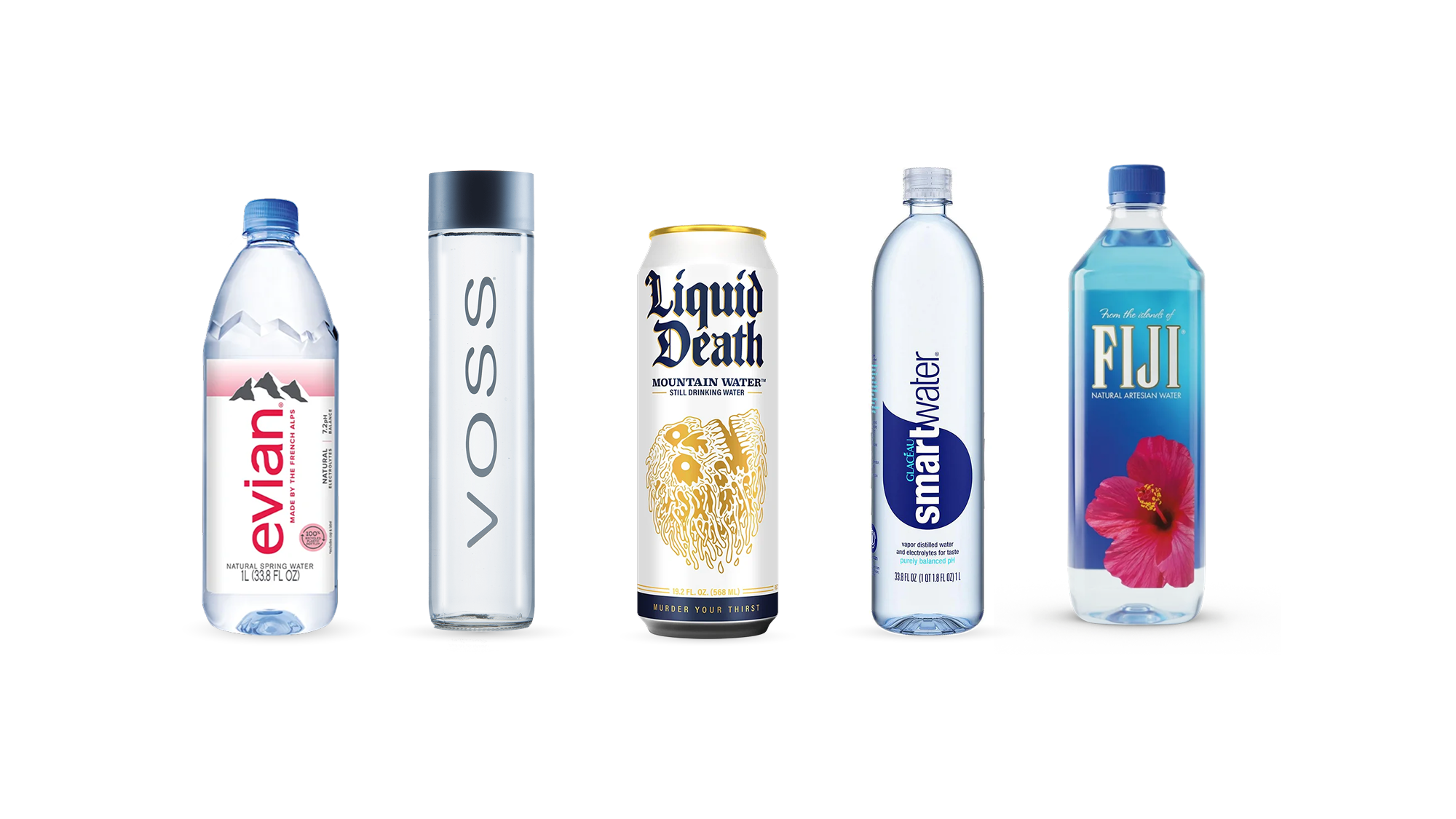
Visual identity, tone, packaging, partnerships — everything then amplifies those positions. Evian is calm, minimal, and heritage, making the product feel timeless and premium (“Born in the French Alps”). Liquid Death is irreverent and loud, with packaging that looks like a tallboy (“Murder Your Thirst”). The Evian logo on a Liquid Death ad would make no sense, and vice versa.
The lesson isn’t that brand magically differentiates commodities. It’s that clear choices and reinforcement work even in one of the most commoditized categories imaginable.
So if you’re working in an AI category that’s starting to resemble a commodity, where do you start? Not with a logo, a tagline, or a launch video.
1. Find your opinionated POV
Start with what you believe that everyone else doesn’t. This is your timeless “why” that outlasts whatever you're shipping next quarter. A real POV attracts some people and repels others. That's the point. Most founders I work with try to skip this step and get straight to logos and launches, the more tangible side of marketing that they can readily observe in others. But POV is what gives everything downstream — your positioning, your visual identity, even your product decisions — a foundation on which to build.
Use your point of view to filter every decision. Before you can segment by audience or platform, you need the opinionated through-line that carries your story to be crystal clear.
A few examples:
- Nike believes everyone with a body is an athlete, and that anyone can choose to be a great one. Their original tagline “Just Do It” is one expression of it. Standing by Colin Kaepernick in 2018 in spite of boycotts and stock dips was another. Their recent stumble at the Boston Marathon is instructive: Nike initially put up a billboard reading "Runners welcome. Walkers tolerated." which faced immediate backlash for “pace-shaming” and was replaced within days with the more timid "Boston will always remind you, movement is what matters." The original copy was a fabulous expression for a company that spent more than forty years telling people to push themselves; the replacement is the kind of line a brand runs when it's afraid of its own POV.
- Duolingo believes learning a new language should feel like a game you can't put down, not homework you have to do. The owl mascot, streak guilt, their willingness to be unhinged on social all follow as expressions of addictive education.
- Anthropic believes that AI should be a collaborative partner to human thought, not a replacement for it. "Keep thinking" is built upon this foundation. Keeping ads out of Claude is a product decision that tracks. Their public refusal to let Claude be used for mass surveillance is another.
No matter how well you articulate your point of view, if no one can understand what your product is or who it’s for you’ll be stuck with a great opinion and an unintelligible product.
2. Create clarity with positioning — and keep it current
A bland POV that makes everyone nod their heads in agreement doesn’t get you very far. And neither does saying you’re “for everyone,” because it doesn’t clarify anything when it comes to positioning. Positioning forces you to make a set of coherent choices:
- Who are you for?
- Why should they care?
- How is the world broken today for them?
- What are you up against?
- What makes you different from how they already try to solve their problem?
Good positioning forces you to make tradeoffs and gives customers a clear reason to choose you.
In the past, I’d nudge founders towards thinking about their competing alternative not as another startup with minimal market share, but the status quo: manual workflows, legacy software, outsourced labor, or doing nothing at all. Rather than compare themselves to more direct competitors, I’d urge them to begin by redefining the problem and articulating a clear villain to their story that their audience would want to root against. A couple examples of companies that did this well:
- Square didn’t initially position against other payment processors. It positioned against remaining cash-only. The early story wasn’t about rates or features, but about access — anyone could accept credit cards. Only later did Square directly take on alternatives like PayPal or traditional POS systems. The point of view underneath was simple: commerce should be easy, and small merchants deserve powerful, beautiful tools to run and grow their businesses.
- Gong initially positioned against “gut feel” sales coaching rather than other tools. Its core argument was that conversations were the source of truth. Only later did Gong sharpen its secondary positioning against Chorus and others by emphasizing opinionated guidance over neutral analytics. The underlying belief: sales should be driven by data, not guesswork.
Today, founders in AI categories don’t have the luxury of time. You often have to fight the status quo and multiple direct competitors simultaneously. People will compare similar tools, and you need a simple explanation for why you win versus the old way of doing things and why you win when the choice is between you and another startup in your space. Positioning used to last a year or two or maybe more. In this market things change so quickly that it has to be a living thing you’re constantly revisiting every few months.
Take Cursor as an example. They didn’t initially position against GitHub Copilot, but against the status quo of writing code in an editor designed for humans, or one with AI added on for autocomplete. At their seed announcement (October 2023), Cursor was "AI-first" which was sufficient at the time. Their POV was that if AI is going to change how software gets written, a retrofitted editor can't match one built around AI from the start.
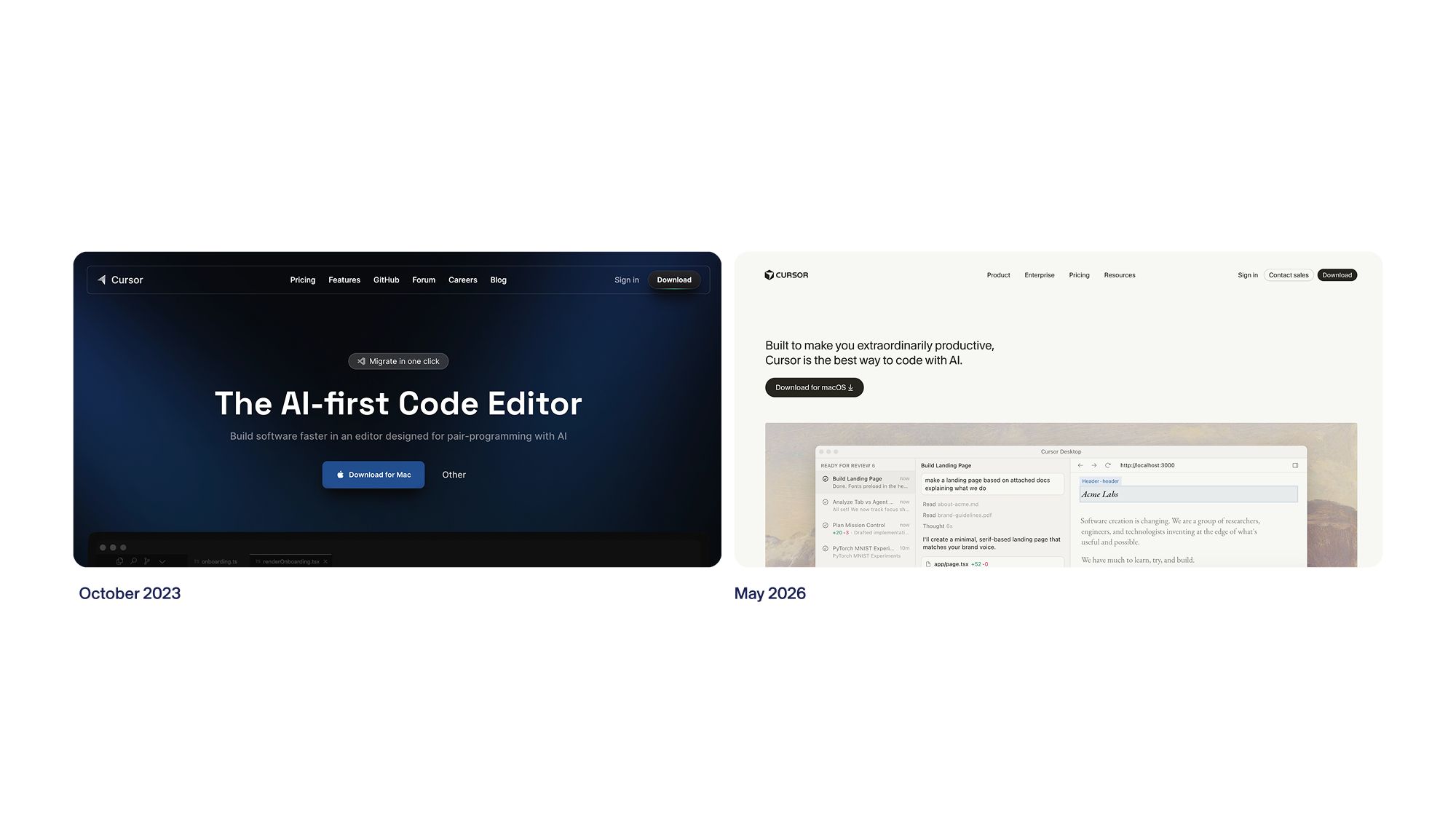
Within months, a wave of AI editors and coding agents appeared (Windsurf, Replit Agent), and Cursor had to fight two fronts at once. Against the new pack of direct competitors, Cursor sharpened around depth of codebase understanding, agentic capabilities and a faster release cadence than anyone else. But the category shifted again when Anthropic launched Claude Code. It wasn't a better IDE — it reframed the question from "what editor do you code in?" to "what agent codes with you?" sidestepping the "AI-native editor" framing Cursor had won. Cursor has since had to reposition around agent orchestration rather than the editor itself. Their original positioning wasn't wrong; it worked in the moment, but the moment changed quickly. And that's the job — not to land on something that lasts forever (like your POV), but to make coherent choices and keep making them as the terrain moves.
3. Use design to bring your unique POV + position to life
Your brand is not your logo or simply a decorative coat of paint on top of your product. It’s who people think you are. So design should be the visible expression of every choice you’ve made so far.
It takes your POV and the clarity of your position and turns it into something people can recognize through visual identity (colors, typography, imagery), language (the tone you use, the phrases you repeat, the things you refuse to say) and your product itself (the defaults you set and the features you choose not to build). It dictates how you behave. Over time, those choices reinforce each other. That reinforcement is what people experience as your brand. If you look and sound like everyone else in your category, it’s hard for customers to remember which one you are.
Here are two simple tests:
- Take your homepage hero, a recent customer email, and a social post. Put them side by side. Do they all reflect your point of view and position?
- Now remove the logo from your homepage and swap it with a competitor’s. It shouldn’t make any sense.
If you’re not happy with the results of those quick assessments, but your POV and position are solid, it’s time to refine your visual and verbal identity.
Make your visual identity unmistakably yours. Do you look like every other company in your space? Too many B2B companies default to the same boring enterprise palettes (blue, gray and white), too many AI startups use the same giant logo in the footer trope (h/t to Emily from Mkt1 for that one). If everyone in your space is blue, be yellow. Granola may have gotten shade for its “wretched” green spiral logo (Heart of Te Fiti, anyone?), but it certainly was a distinctive choice. If you're ironically punk like Liquid Death, go ahead and lean into those goth headlines and metallic foils.
Let’s nerd out with some basic evolutionary neuroscience: us humans walk around with amazing machines in our heads that are designed to attend to novelty and ignore the familiar — evolution wired us this way to survive. Think back to our hunter-gatherer days. If we ate all the red berries and were fine, and then we encountered some purple berries, it made sense to stop and think about them a bit more than the red berries we knew weren’t poisonous. For you engineers, your brain is looking for the diff.
But if something is too novel, the brain flips from curious to suspicious. Imagine our ancestors found a sparkly silver berry! That would be weird. In visual design, I often push founders who copy other startups toward distinctiveness. And I nudge creatives who err the other way back toward "maximally different but recognizable" — the optimal distinctiveness of purple berry, not the too wacky silver one.
Kill the jargon and have a personality. Do you have five adjectives that describe your brand personality ("human" and “trustworthy” don’t count)? Does your copy reflect them? Do you use big words to say stuff that could be said with more clarity? If you’re expressing something complex, can you explain it like you would to a smart but bored teenager? Make it interesting. Make it a story. Don’t write the same hedged copy designed to offend no one. If everyone is loud, be quiet. Make sure these choices make sense with your positioning and point of view.
Competitors will replicate your features and technical gaps will narrow. A good brand creates a specific kind of friction: copying your choices makes them look like a parody of you. Clay is one company that does this very, very well.
Clay: Clear POV + position + distinctive assets = friction against imitation
If you were driving up the 101 from SFO last fall, one billboard stood out from the rest. It didn’t have the generic, dark mode, scifi-inspired vibe of every other AI company ad, which looked like AI made them without a good brief. It was bright, with the childlike rainbow Clay logo partially chiseled out of a marble block and copy that made a clever claim. If you rode the NY subway earlier this year, you may have seen a version of this plastered there too. This campaign may be the cleanest expression of the company’s POV (go-to-market is creative work) and position: Clay makes creative tools for growth teams.
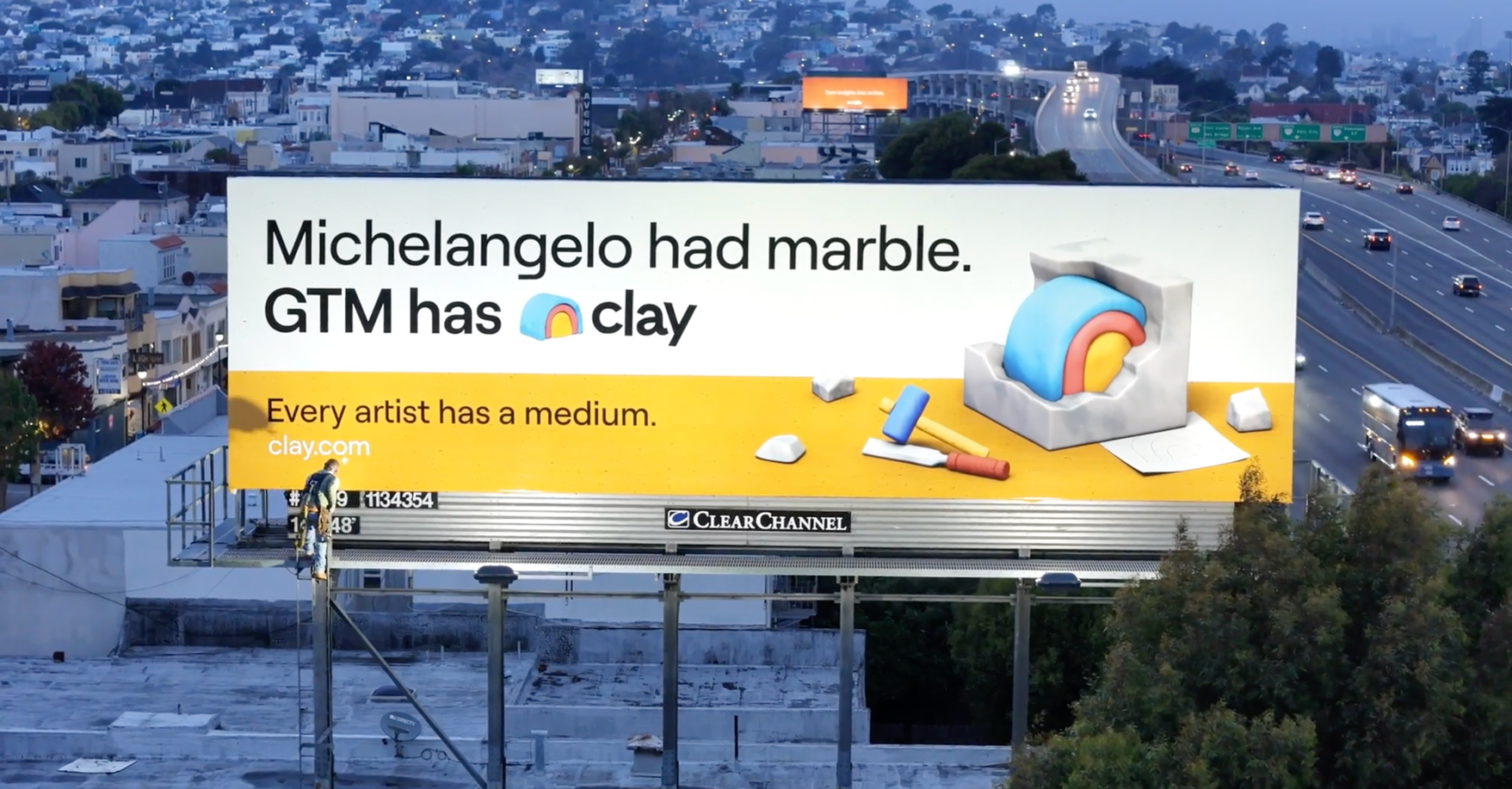
While they began as a horizontal no-code spreadsheet, Clay ultimately found its footing after narrowing in on go-to-market teams doing outbound as their target customer. They positioned themselves against spammy outbound and manual go-to-market workflows first and other data enrichment tools second. They took a problem (incomplete contact data) and reframed it into an entire category that felt rigid and uncreative.
The company’s claymation visuals, colorful palette, and the videos they post regularly — from “off the cuff” ones from co-founder Varun to documentary style customer stories — all reinforce the same idea: creative tools for modern GTM teams (they coined the “GTM engineer”). Instead of your standard founder-talking-to-the-camera launch video, they recently announced a new feature (“Functions”) which standardizes workflows with renowned pizza maestro Mark Iacono of cult Brooklyn spot Lucali likening it to the consistency of his dough:
 Jake Block
As they went from $1M to $100M in ARR, Clay’s production quality improved. They now have a “studio” team. And it’s no surprise that while many people in tech want to become founders, many people at Clay dream of becoming artists or therapists.
If a competitor adopted their look and feel and their language, or even their video style tomorrow, it would seem ridiculous.
Don’t outsource your brand to LLMs
You don’t have to avoid AI altogether — the key is using AI in a way that reinforces good decisions. It’s tempting to prompt your way through positioning and generate infinite content. But AI amplifies what you feed it, so if your POV and position are generic, it amplifies generic.
LLMs work by producing something close to the statistical average of everything ever written. The more companies route their choices through them, the more everyone converges on that average. The people getting genuinely good outputs from AI right now are the ones walking in with sharp inputs: an opinionated POV, positioning that picks a fight and a design system with distinctiveness built in. When those things aren’t sharp, AI is a marketing slop machine.
Emmett Shine is on the bleeding edge of embracing AI at his brand studio, Little Plains. For a recent project, he hired his artist mom to handpaint original watercolors, then scanned them into custom node-based workflows to generate and animate new scenes, iterating between the real source material and AI systems. As Shine put it: "A creative cycle between real materials and generative systems that stays human no matter how far it scales."
How do you tell a story about cutting-edge science that feels like it's about love and family? We hired my mom, a professional painter, to create original watercolors.
— Emmett (@emmettshine) March 26, 2026
Conception is a stem cell biology company working to help families have children who might not otherwise be… pic.twitter.com/moWNc6mATb
And instead of only delivering human-readable brand guidelines in a traditional PDF, Little Plains also delivers structured data for agents: “Same positioning, voice, and values, just two formats.” When those choices are articulated for humans and AI alike, they become infrastructure to scale coherence.
To further fight against AI-democratized sameness, you have to do things that are hard to replicate via AI alone. Show up in person. Be personal in your storytelling. Make physical things.
If anyone could outsource brand to AI, it would be the frontier labs, yet Anthropic opened a pop-up Claude Café in the West Village with “free coffee and thinking caps while supplies last.” When online output is infinite, offline craft like this stands out.
Consider how most people choose between ChatGPT and Claude — it’s probably not by reading evals, but increasingly based on what kind of company they want to associate with (ahem, brand). Each company has made a set of choices about how it shows up. These decisions turn some people off and others on:
- OpenAI is aggressive and expansive. This shows up in a broad product surface area, a rapid shipping cadence, aggressive consumer distribution, and a techno-utopian tone. The key message of their Super Bowl ad, “You can just build things,” reflected this perfectly.
- Anthropic leans into restraint and responsibility. They emphasize safety and careful progress. Their Super Bowl ad series showed the tragic comedy of putting ads into an AI assistant (clearly poking fun at ChatGPT) — something they’ve committed not to do with Claude. Claude exists to help you think, not to sell to you.
The “Department of War” feud earlier this year sharpened that contrast. In late February, Anthropic refused to remove safeguards that prevent Claude from being used for mass surveillance of Americans or fully autonomous weapons. The government designated Anthropic a "supply chain risk," a label typically reserved for foreign adversaries. Meanwhile, OpenAI signed a major contract with the DoW, initially claiming it included the same ethical safeguards Anthropic had fought for. Reports later indicated they'd agreed to the DoW's requirement that the AI be used for "all lawful purposes."
Models converge and the frontier keeps moving. But these decisions, especially when made on such a public stage, act as real differentiators. Claude hit #1 in the App Store within days of the public fallout after sitting around #20 the month prior. They didn’t launch a new model or release a new benchmark. They made a choice that reinforced their brand.
Brand is a transient advantage, not a moat
Most AI startups won’t build advantages that endure unchanged for decades. Differentiation will be temporary, contested, and frequently reset — what Rita McGrath called “transient advantage.” Brand is another one of these. Like other advantages, it erodes if it isn’t maintained and doesn’t evolve. Its edge comes from your choices not converging with everyone else’s.
That’s the job. You can’t install distinctiveness once and enjoy it forever. "AI-powered" was a position founders adopted in 2023 and tried to coast on. For a minute, it worked. Then other companies in every category said the same thing and soon "AI-powered" stopped meaning anything at all. There’s still hope: if water can sustain radically different brands, AI products won’t just be able to — they’ll have to.
Founders have to think about brand differently in a category that starts to resemble a commodity:
- Find your opinionated point of view. This has always been important, it’s just even more so today.
- Create clarity with positioning — and keep it current. Positioning forces you to make distinct decisions about who your product is for and what it does in relation to what they already know.
- Use design to bring your POV and position to life. Establish a unique identity that you can own, so it would be painfully obvious if another company were to copy you.
- Give AI sharp inputs to scale your brand. Bland inputs result in bland outputs. That’s part of the reason so many AI companies look and feel the same.
- Keep making coherent choices. As the terrain keeps moving and the tools that were supposed to give you leverage start producing the same outputs for everyone else, you need to continually reinforce decisions about what you believe, who you’re for, how you show up and what you refuse to do.
If you've got solid inputs, AI can be the most powerful amplification tool you've ever had. If you don't, it's the fastest way to disappear into the category.