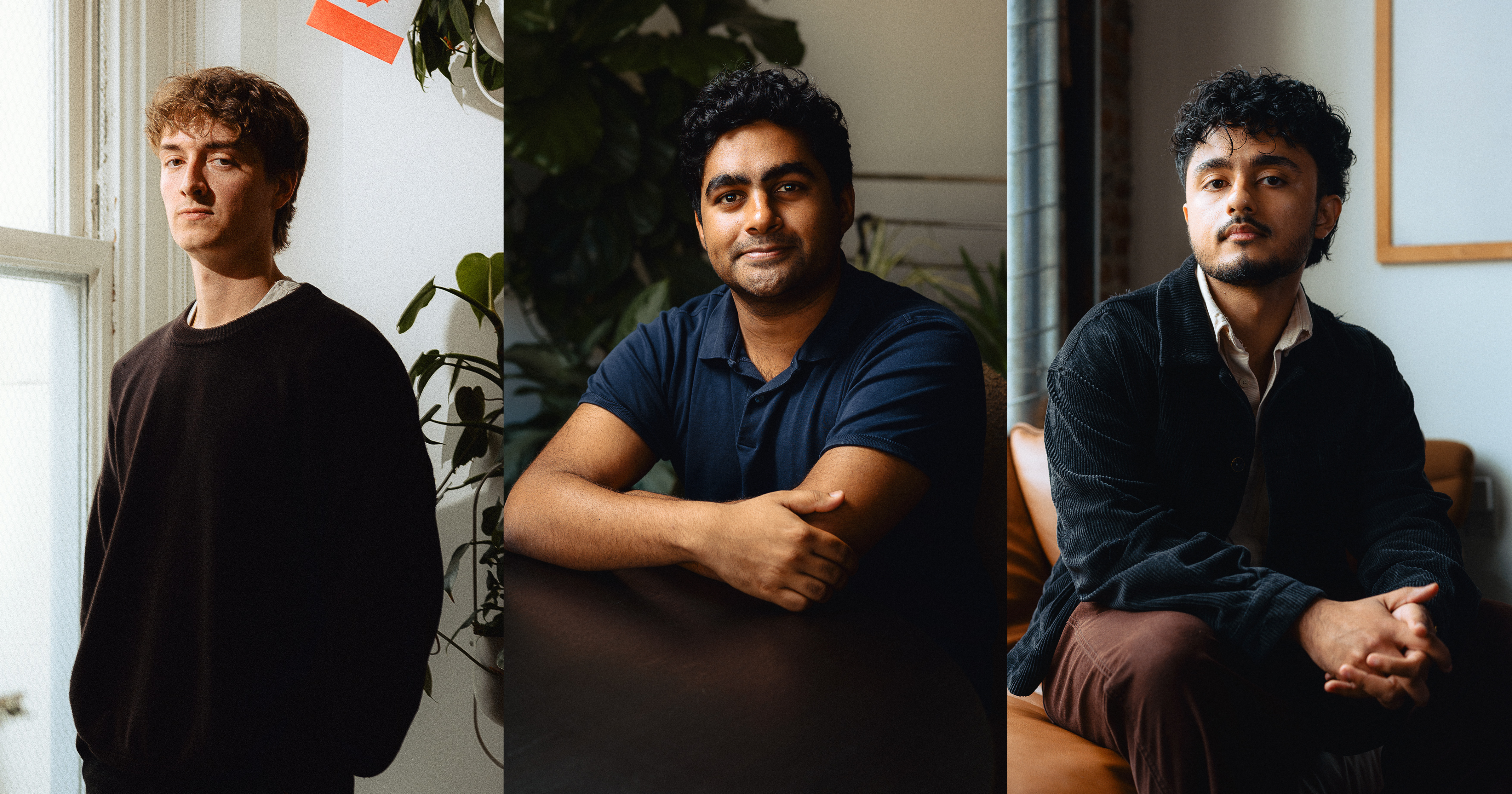
Always on: What it’s like being a twenty-something founder in the age of AI
By Nate MartinsPhotos by



“My worst fear is looking back at this time with regret for not taking advantage of the opportunity in front of us,” says Max Brodeur-Urbas.
He was 24 when he started agent builder Gumloop and has raised $70M since founding three years ago. “I’m always wondering, ‘What is stopping us from getting this done today?’ I try to shorten timelines as much as I can,” he told me.
Brodeur-Urbas shares a similar sentiment with two other twenty-something founders I spoke with who are building in the era of AI: there’s a massive window of opportunity and they’ve got to move fast before it closes. Technology keeps expanding what they can build and how quickly they can build it — both for them, and their competition.
“I’m just monomaniacally focused on making sure we’re moving the puck forward,” says Yash Patil, the 23-year-old co-founder of training and inference company Applied Compute, which just agreed to be acquired by Palo Alto Networks in a $4.5 billion all-stock deal. He spent two years at OpenAI before starting the company at 22 and raising $510M in a little over a year. And at 24, Adit Abraham left Google to start Reducto, an AI document-parsing startup that raised $108 million within a year and a half.
None of these founders see their age as a disadvantage. On sales calls, they feel the desire of enterprise executives who want to work with them because of their AI fluency. With relatively few obligations outside of work, they can dedicate an insane amount of time to their companies — even if their own relationships must take shape around their obligations to their businesses and time away can physically feel uncomfortable.
But they’re still learning how to lead experienced employees, negotiate important contracts and manage their emotions through the ups and downs of running a company where they can see the window closing by the centimeter. Their employees have bet their careers on the founders’ ability to figure it out.
I spoke with all three to understand what it’s like to be a founder at this age, in this age: where being young gives them an advantage, where experience still matters, and how they decide how much of themselves to give to an opportunity they’re afraid to waste.
Everyone’s your competition now
“There’s a problem that exists right now that won’t exist in the future — automating the work everyone hates and helping people be more efficient. It's up for grabs. We can be a huge player if we do our jobs right. Or we could just be a blip that tried something and failed,” says Brodeur-Urbas.
The best founders have always been obsessed with their companies. But the circumstances of the current moment — when anyone can build anything extremely fast, unbound opportunity breeds intense competition — make everything feel so pressing that obsession is almost requisite.
Each of these founders feels like the opportunity to succeed is within their grasp. But they also feel like there are more hands reaching for it than ever before, with more (and maybe even younger and more AI-pilled) startups spawning every day. Maintaining perspective is difficult when the ups and downs are felt so viscerally.
“The share of the opportunity is so much larger than any one given company but on a day-to-day basis, it’s so easy to get wrapped up. Like if you see a competitor in a given deal, it feels like you’re fighting for the same little nugget. I think as a young founder, it’s harder to zoom out of that perspective,” Abraham says.
Brodeur-Urbas tries not to focus on competitors, but it’s hard when everything about your company feels so personal. “Any user churning, every win, it feels like it’s tied to who you are,” he says. “I won’t name them because I don’t talk about our competitors — but when a competing company comes out with something that is very clearly inspired by what we’re doing, chasing the same slice of the pie. That always feels like shit.”

Even among peers, it can sometimes feel like a real-world X feed. Brodeur-Urbas is in a group chat of founders but believes that focusing too much on people who are similar causes an echo chamber. Abraham even finds himself being guarded around other founders, worrying that what he says might make its way through what he calls the VC grapevine: “The number of founder relationships where you can truly be unguarded and talk about your problems earnestly is reasonably limited, which sucks,” he says.
Patil brings a slightly different perspective, describing it more as a “frenemy” dynamic that both fuels pressure but also creates more opportunities than before because there’s so much more surface area. “The mandates of any one company have expanded. You’re doing X, and AI lets you do X a lot better and faster. So now you can do Y too, and you’re going to have more overlap.”
But with ever-expanding competition comes ever-expanding possibility, which Patil was fortunate enough to experience at the frontier.
AI has given Patil opportunities unexpectedly early in life — including the opportunity to work at OpenAI at just 20 years old. When he was considering leaving Stanford his sophomore year to do so, Sam Altman offered to call Patil’s worried parents to ease their concerns.
He grew up hacking around in Austin, Texas, encouraged by his chip engineer father to build his own coding projects and inspired by his older brother starting his own career in tech. When he got to Stanford, he spent his first year “funmaxxing” by building lightsabers out of aluminum tubes and a dining hall voting app. Summer after freshman year, Patil and his friend, eager to tackle a real-world problem instead of tarpit startup ideas centered around college student grievances, turned down internship offers with startups to build something that might land some real paying customers.
They knew their way around the venture capital ecosystem that hovers around Stanford computer science majors, and got several offers for small checks. But Patil felt iffy about taking “free money,” thinking there would be strings attached if it didn’t work out. So he sent an email to Sam Altman asking for advice (he’d recently been invited to a dinner for Stanford builders hosted at Altman’s home).
Altman wrote back saying, “I’ll never encourage anyone not to go and build stuff. If you’re worried about taking someone else’s money, I can fund you for the summer, you can always return the capital if you decide to shut it down.”
Patil and his friend took Altman’s stipend to build an app to help e-commerce companies purge their link rot. It didn’t work very well, and neither of them ultimately found e-commerce very interesting. Patil describes it as a “whiteboard company,” a startup idea somewhat arbitrarily plucked off of a brainstorm list. They wound it down and returned to campus for the fall of 2022.
Then ChatGPT came out, and Patil was mesmerized. He emailed Altman again, this time inquiring about a job at OpenAI. Altman encouraged him to apply to their six-month research residency program — which would require him to drop out of school.
Altman’s offer to call was enough to soothe Patil’s parents’ nerves. “I told my parents that Sam offered to talk to them, and they were like, ‘Oh wow, no, we don't need to take his time. He's so busy. Just the fact that he wanted to call us is fine,’” he says. His older brother, on the other hand, told him to go for it.
Patil spent more time at OpenAI than he did at Stanford. When his colleague Ian Osband found out he wasn’t 21 yet, he planned him a 21st birthday party, featuring a branded party bus, a fat suit for Patil to wear and drinks at the Mission craft cocktail bar Trick Dog, down the street from the OpenAI office.
His experience at OpenAI taught him a lot of things he’s grateful to have learned before he could legally buy a drink: How to work with other people, exposure to real-world problems, what great leadership looks like.
“I got an amazing shot on goal at such a young age, which I was probably undeserving of given my background,” says Patil. “I didn't even graduate, I didn't even have any AI experience. I was supposed to be on ChatGPT engineering, and then a couple days before I joined, my manager told me they needed more people on post-training infrastructure research.” This was fertile ground for what would become his training infrastructure company, Applied Compute.
Being able to work before starting a company is probably one of the luckiest things that happened to me.
— Yash Patil, co-founder and CEO of Applied Compute

Youth sells
When Brodeur-Urbas has sales meetings with a buttoned-up enterprise company, he’ll show up in a T-shirt and Birkenstocks with socks.
“I don't think the way you dress should matter at all if you have a world-class product. Dressing up to take a meeting feels like effort spent on the wrong thing,” he says. “Large companies generating billions in revenue are pretty stuck in their ways, so they’re frantically looking for ways to keep up. We can address that for them — maybe being younger helps with everything changing so quickly.”
The response to ever-expanding competition, universally, seems to be to just ship more and ship it faster. Tactically, there’s more of an ability to do this right now — but what’s more unique is the aura associated with speed in the AI era, especially from an older generation (in many cases, executive buyers). Every founder I spoke with agrees they’re leasing their AI-nativeness out to established companies — playing into the unspoken hope from buyers that the youth will rub off on their organization.
“There’s usually a subset of people in leadership who think their company is moving too slow, and they need new blood, new ideas. I’ve chatted with people who are super excited because we ‘know AI stuff.’ We’re young, and we move fast. We’re not a nine-to-five shop,” says Patil. “I don’t think we’ve ever had a situation where people thought us being young was a negative thing.”


When Gumloop was recently trying to win a deal, the customer requested a set of new features at 10 AM. By 5 PM, Brodeur-Urbas had sent a walkthrough video of everything that was already built, tested, reviewed and live in production. The company didn’t even end up using the features, but he didn’t care, because he'd proved Gumloop could help that customer keep up with the industry. “If they’re considering us against a competitor, their perception of us has totally changed. I have a quip I drop in demo calls: ‘We have same-day shipping like Amazon.’”
Abraham finds authenticity to be especially effective when selling in established enterprise environments. He’ll bring somebody from Reducto’s sales team, and they’ll wear a button-up or a suit, and he’ll wear his usual hoodie. “There's something useful about having a level of irreverence toward trying to conform. I’m not pretending at all. I’m a five-foot-five Indian dude who immigrated to the U.S. I’m not going to look like the enterprise C-Suite, and that’s okay,” he says. “I feel really comfortable with this idea that yes, I’m younger, and maybe that comes with stipulations around experience. But on the flip side, we’re in such a new market that didn’t exist until a few years ago. So I’m not going to be the person who wins a deal by knowing how to play golf, but I can truly speak to the product.”

Patil says that even with little formal experience at 23, he feels he can meaningfully contribute because everything in AI is so new. “The maximum amount of experience people have with training models is five years. That’s why you see so many young researchers who are the GOATs in the field, because no one’s been doing it that long,” he says. “It’s not like software where you can go hire someone who’s been working on infrastructure for 20 years, because they’re obviously going to be better than a new grad. We’re probably the most experienced people in the world.”
Brodeur-Urbas can sense when folks expect him to be a caricature of a young founder. “I think sometimes people assume the ego that’s associated with young founders will be something I have,” he says. “They’ll assume before we meet that I’m going to be this annoying guy who’s on their phone and not paying attention. And then we talk and they realize I’m not like that.”
Ultimately, he thinks his youth is just an amplifier of being good at what he does. “If you’re doing a good job and you're young, it’s beneficial. But if you’re doing a bad job and you're young, it’s way worse,” he says.
There’s no off-switch
When Abraham is at the grocery store, he’s thinking about ideas for Reducto. When he goes to bed, he’s thinking about something related to Reducto. When he wakes up, he immediately picks up the Reducto idea he fell asleep thinking about.

Patil falls asleep with his laptop on his belly, lights still on. He actually finds it uncomfortable to step away from work.
It's more comfortable for me to be on than it is for me to be off. I have this feeling that if I’m not locked in, something bad is going to happen.
— Yash Patil, co-founder and CEO of Applied Compute
Brodeur-Urbas works until around 1 AM at the office, and then he takes a Waymo home, walks in the door, brushes his teeth, and lies down, and within five seconds he’s asleep.
I’m not clock-watching, but I bring up the 9-9-6 stereotype. Interestingly, every founder bristles at it, even though most of them clock those hours (and realistically, more) on paper most weeks. Nearly every waking moment, these founders are consumed with running their companies.
But they’re mindful to not frame this schedule as requirements or mandates to their employees. The founders recognize their age awards them circumstances to be tenaciously focused on company-building and place a lot of pressure on themselves to perform as a result.
“Some people have to take care of family, children or have certain financial circumstances. I'm very privileged to be able to give my full life's focus to Gumloop,” says Brodeur-Urbas.
“Telling people when they have to show up and leave can create a really toxic culture that people get tired of, especially when you want to hire great people who have a lot of options,” he continues. “I’m never going to tell someone with a kid that they can’t be at their Saturday soccer game.”
Abraham says he sees a lot of companies that are vocal about 9-9-6. But he doesn’t treat time as an input — doing so, he says, is performative. “There are certainly going to be weeks where you need to work seven days in that week, and then there are also probably weeks where you don't need to work over the weekend, and you should find your own balance for that,” he says. “The market doesn’t care how hard you tried. The market only cares about what you produce, and I personally don't like the idea of patting myself on the back because I worked a lot of hours in a given week.”
Abraham believes the job of being a founder is embracing the fact that building a company seeps into every inch of your psyche. “You can’t take a half-step toward building a startup. It’s less about the hours, and more about how all-consuming it becomes. The company becomes an extension of your identity. I can’t separate Reducto from me. You can call that unhealthy,” he says.
Every one of these founders understands the bet their employees took on each of their companies. With so many companies to choose from and seven-figure comp packages from AI labs flying around, they feel an obligation to succeed.
“If people are going to spend the primes of their lives and grind like this and work really hard — and we fail? That fucking sucks,” says Patil. “People really took a bet on us, and we have to do a good job for them and make the right decisions.”
But at what cost?
“It’s hard to turn off. I’ll be hanging out with my girlfriend for an hour or two, and we’re doing something fun, and I’m still thinking about work stuff,” says Patil.
“I had a six-year relationship that ended around the time I started this company because all I could think about was building the business. I was probably a pretty bad boyfriend, honestly,” Brodeur-Urbas told me. “She wanted to go explore Europe, and I was like, ‘You should do that. I really want to move to SF,’ and we just agreed to part ways.” Now, he’s dating someone who’s equally devoted to her career, and they often spend Saturdays together at the office after a morning at the gym or surfing.
Brodeur-Urbas’ parents instilled high expectations by forcing very little on him.
He grew up in Montreal with busy but always-home-for-dinner lawyer parents. Just as he seems to understand now running a company, his parents knew that force is an inferior form of motivation. They never made him do anything — sports, homework, chores. He’d procrastinate math homework until 6 AM the day it was due, and his parents never intervened, because they knew he’d get it done. Even yardwork was framed as a favor, not an order.
Over the summers, he went to Camp Hurontario, a boys’ summer camp on a remote island in the Georgian Bay that was only accessible by boat. He got some early management training in being a camp counselor, which taught him how to make a group of a dozen 13-year-olds in the wilderness get excited about eating pepperoni sticks for breakfast in pouring rain. “In that scenario, I would probably start a chant, as stupid as that sounds, or make a game out of who can paddle the fastest,” he says. “Building a company is the same in that nothing matters more than people’s attitude.”
He went to McGill to study software engineering and landed a job at Microsoft’s Seattle HQ working on Linux. He says he felt like his job was fixing people’s WiFi. But he’s glad it was a job he hated, because otherwise it might have shrunk his ambitions. “I'm actually grateful that I got a role that was such a bad fit for me, or else I probably would have stayed in a normal job that felt okay,” he told me.
One night his coworker friend had a shrooms-driven epiphany that they were wasting the most important years of their lives at jobs they found boring — and he was convinced they should quit. Brodeur-Urbas didn’t need to take any shrooms himself to see that he was right. They both quit Microsoft on the same day.
He ventured off on a year of tinkering, working out of a co-working space in Vancouver, messing around with VR games and a VR dating app — “in hindsight, a terrible idea.”
Then came ChatGPT, which Brodeur-Urbas heeded as the same “go build” rallying cry as it was for Patil. He noticed AutoGPT picking up steam on GitHub, and felt consumed by the idea that there was growing demand for automating knowledge work. “I never had the intention of being an AI founder specifically. I just started solving a problem for myself while I was playing around with ChatGPT. It just seemed like everyone was so excited about agents doing work for them, and the promise was so huge,” he says. “I remember being in the office until midnight, and normally I would leave at around seven because I would force myself to stay until then. I didn't feel the need to force myself to work on this, because it was just really fun.”
I was so hungry for an idea to pursue that when I found it, I thought, how could I not run at this full speed?
— Max Brodeur-Urbas, co-founder and CEO of Gumloop

Inexperience and intuition
The fundamentals of running a company, like hiring and managing, don't seem to be any easier to learn today as a young first-time founder than they were twenty years ago.
“I’ve never managed anyone before in my life, and now I manage a 70-person company,” says Patil. But he fills in his lack of experience as a manager with a sense of mutual respect for his employees. “I think where those sorts of relationships get weird are when the CEO is like, ‘You have to listen to me, your ideas are dumb,’ and the other person is like, ‘This guy’s younger than me, what the fuck does he know?’” says Patil.
He admits the one downside of running a company at his age is a challenge faced by just about every 23-year-old: Getting over something. “Being able to compartmentalize the shit that happens every day has been my biggest learning curve,” he says. “Running a company, you get thrown a curveball every day. And you just have to deal with it and move on. And obviously, age and experience help with that. There will be good things that happen, and there will be bad things that happen, and you can’t over-index on one.”
But for the most part, Patil doesn’t feel like his age is holding the company back. “Maybe there’s some stigma that we’re young and we don’t know what the fuck we’re doing. We’ll just prove them wrong.”
Brodeur-Urbas has come to learn that some tried-and-true company-building tactics, like the need to hire enterprise sellers to grow, can’t be rendered obsolete by first principles thinking. “When we raised our Series A, I was kind of cocky and thought we could stay lean and scale infinitely, generating more interest on our own. But then we realized enterprise sales is the way to go,” he says.

Meanwhile, Abraham tells me he “shat the bed” the first couple times he navigated procurement for an important deal. He’s had to learn how to tackle plenty of things he’s never encountered before, from scaling himself as CEO of a multi-product company to fighting entropy as the company grows.
But for him, “skill issues” are motivating. “I’ve gotten opportunities that I didn’t earn. There are plenty of things that even today I’m not the most skilled at. But from the start of the company, I’ve felt really confident about my ability to get better.”
He says the glass-half-full of inexperience as a young, first-time founder is leaning into your intuition. “Intuition is one of the most powerful driving forces for anything that is ambiguous in nature,” says Abraham. “For pretty much any company, that exact company has not been built before. Maybe the same market has existed, or a similar solution has existed, but the specific collection of people coming together to tackle a problem in a certain way is new. You have to have your own orientation around what that should look like.”
For Abraham, the ability to shape his own outcomes is a privilege.
On the heels of the 2008 financial crisis, Abraham moved with his parents from Delhi, India, one of the most populous cities in the world, to Salisbury, Maryland, a rural chicken farming town with a population of 30,000. Most of what he knew about American culture came from watching The Suite Life of Zack and Cody. He was amazed by the common luxuries of a middle-class life in America that were out of reach to his cousins back in India, like central air conditioning.
When I ask him where in his childhood he thinks his inclination toward company building comes from, he points to his parents’ determination and gratitude for their sacrifices. “There's something really powerful about my parents facing hard situations and making it work again and again, which doesn’t necessarily pan out into entrepreneurship specifically, but it certainly does breed entrepreneurial traits,” he says. “There was always this notion of doing something great to justify the opportunities we'd been given.”
A really big part of deciding to start a company is this deep-rooted belief that you can create your own circumstances.
— Adit Abraham, CEO and co-founder of Reducto
After several flickers of entrepreneurship early in life — from farming “Panda Bucks,” his elementary school’s reward system for good grades and good behavior, to running Instagram syndicate pages for a productivity app — he studied computer science at M.I.T., and got a job post-grad at Google.
The accomplishment of getting in the door at Google wasn’t lost on Abraham. He got to work on Google Search, a product he adored as a kid. “For Indian families, Google is the gold standard. Back in Kerala you’d get an article written about you for getting a job there,” he says. So it felt strange for him to consider an acceptance to Y Combinator after taking his beaming parents on a tour of Google’s office.
But he eventually felt that his output was constrained by big-company politics. At Google, his manager walked him through how many people per VP could get the “transformative impact” performance rating, and explained to him that because someone else was up for a promotion, he had to reserve the rating for that person.
“I just had this deep feeling that I was capable of doing more,” says Abraham. “Knowing that my constraints were the circumstances around me, and not my own inputs, was really frustrating. The nice thing about founding is it's the complete opposite — if you do the wrong things, you get nothing. But if things work out, it's a very uncapped process.”

Even at the end of a however-many-hour work week, everyone has their own way of unwinding.
Patil says he just doesn’t get out much. “I don't have much of a social life at all. I'm extroverted and like spending time with people, but I also get tired and don’t want to go to a party. I’d rather just go home.” Instead, he likes driving his dad’s 2014 Honda Accord up Highway 1.
For Brodeur-Urbas, it’s laser tag, or taking guitar lessons, or watching YouTube wilderness camping and car maintenance videos.
Ultimately, I think they’re all pretty grateful that this is how they’re spending their twenties.
“I have genuinely never felt more fulfilled with anything than I do working on this company, even in the most shitty moments,” says Abraham. “Someday I'm gonna look back on this time as such a cool transformative period. So there's something fun about the unfun things, too.”
Brodeur-Urbas went to Hawaii on vacation last year. While he was sipping Mai Tais in the pool, he wished he had his laptop. “Staring out at the ocean while I have a team in the office betting their careers on Gumloop felt almost disrespectful,” he says. “Someone doing something exceptional wouldn't be doing that.”
He hasn’t been on vacation since then, and he’s having a great time. “How you spend your days is how you spend your life. So I’m pretty conscious of the fact that these are the prime years of my life, and I’m spending them in the office. Am I okay with that? I am, because I’m having a lot of fun.”