
This post is by Kim Scott (@kimballscott), Co-founder and CEO of Radical Candor, Inc., former Google and Apple exec, and advisor to Twitter, Dropbox, Shyp and others. Her first post on Radical Candor went viral last fall. Here, she looks at the topic from a new angle.
In honor of International Women’s Day yesterday, I want to explore why gender issues make it harder for both men and women to be candid at work, and to suggest some ideas for addressing the problem. Here’s the short version:
Gender politics and fear of tears push men away from being as radically candid with women as they are with other men. This is bad for men, women and the truth. Gender bias pushes women away from being radically candid in a way that is also bad for men, women and the truth.
Before I unpack these statements, tell a few stories and suggest some solutions, I’ll explain 'Radical Candor' briefly.
Radical Candor
The difficulty of being candid is NOT a gender issue. Everyone has a hard time with it. Last November, I gave a talk at The First Round CEO Summit describing Radical Candor, which is the ability to give feedback in a way that challenges people directly, and at the same time shows you care about them personally.
Radical Candor is rare because criticizing employees can feel brutal, and praising them can feel patronizing. But praise and criticism are, as Ben Horowitz, the venture capitalist, once put it in his blog on management, “The unnatural atomic building block atop which the unnatural skill set of management gets built.” Giving praise and criticism is just the beginning. Great bosses must also get it — especially criticism — from employees, and encourage it between them too.
While analyzing why praise and criticism are such “unnatural acts” for most people, I found there are two especially common reasons:
- Most people have been taught since they learned to talk some version of “If you don’t have anything nice to say, don’t say it at all.” When they become bosses, the very thing they've been taught not to do since they were 18-months-old is suddenly their job.
- Most people, since they got their first job around age 18 — at a time when their egos are fragile but their personas are just starting to gel — have been exhorted to be “professional.” Too often, that’s code for not “getting personal” with anyone at work. But to give praise and criticism effectively, you have to care personally. You have to give a damn about the person you’re talking to. It's your job to care.
That’s why being radically candid is hard. One of the best ways to make it easier is to remind people what happens when they fail to care personally and challenge directly.
Obnoxious Aggression is what happens when you challenge, but don’t care. Ruinous Empathy is what happens when you care, but don’t challenge — and 80% of management mistakes happen as a result of Ruinous Empathy, in my experience. Finally, worst but also fortunately comparatively rare, is Manipulative Insincerity — when you neither care nor challenge.
I’ve boiled this down to a framework with four quadrants:
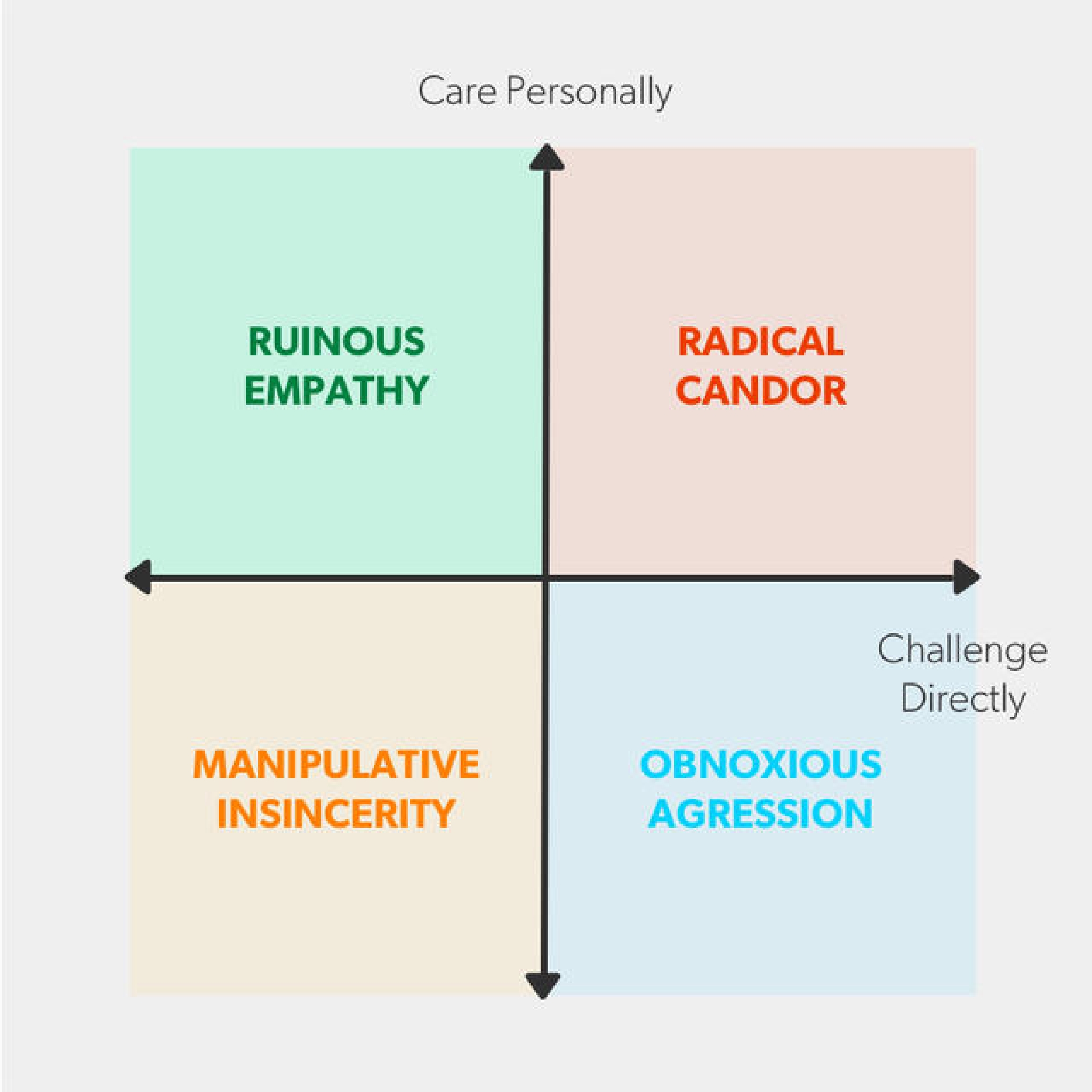
How does gender play out in each of these quadrants? Let’s take a closer look.
Why Gender Politics & Fear of Tears Makes Radical Candor Harder for Men
I was recently talking to a physics professor whose student didn’t know the quadratic equation. (I don’t remember it from high school algebra either, but I’m not majoring in physics.) Stunned, and wondering how she’d gotten this far with such a gaping hole in her knowledge, the professor told her she needed to learn it immediately. Furious at the criticism, she slammed him in his rating as a teacher.
This didn’t start out as a gender issue but it became one. The initial problem was that this young person, like so many others, was unused to criticism — a phenomenon explored well in an Atlantic article I like, The Coddling of the American Mind. But the professor's colleagues, many of them well-meaning men trying to be sensitive to gender issues, somehow made the rift into one. Suddenly, telling a student majoring in physics that she needed to learn the quadratic equation became a risky thing for professors at this institution to do.
This situation was bad for the student who didn’t learn what she needed to know to succeed. And it was bad for all the female students this professor taught after her. Understandably, he became more hesitant to criticize the work of his female students than his male students. But to grow in their field, these young women, like their male counterparts, needed his criticism. The situation wasn’t much fun for the professor either. Real teaching — the reason why he’d chosen his profession — became risky.
This scenario illustrates a trend that's creating a perfect storm in higher education — and blowing through all companies where millennials are working today:
The trend is not to criticize or even to expose people to facts that might be perceived as “disturbing” from history or literature or any other field. Combine that with gender politics, and learning takes a real hit. Will the tone of the current "campus conversation" (or lack thereof) backfire and reduce mentorship and learning for women? I’m focusing on gender in this article, but there are important parallels in race — and anytime relationships cross group boundaries.
The strange case of the quadratic equation is extreme, but milder examples happen every day, and not just with college students, but with middle-aged people working at companies that pride themselves on being data-driven.
Recently, I was talking to a close male friend who’s an engineering leader about the issue of women in tech. I suggested he ask a woman who works for him — a person whose career he's supported and nurtured for years — what she thought. He looked up at me with real surprise. “I can’t talk to her about that! It’s too fraught,” he said.
This came from a man who's not just unbiased but truly sensitive to bias and determined to stamp it out. He catches things even I miss. So if he can’t have a radically candid conversation about gender issues with a woman he knows well, we’ve hit a real low. But the problem is not him, nor the woman who works for him. I know them both, and I'm pretty sure that the conversation would’ve gone well. It's that the swirl around gender issues has everybody walking on eggshells.
Another male colleague recently got caught in a firestorm by making an important and logical point about gender in the workplace. Phrases he used got taken out of context and blown up in the press and throughout social media. This is another man who’s committed to treating everyone he works with fairly, and regularly throws extra energy into fostering the careers of his female colleagues. But after this kerfluffle, he decided he wasn’t going to talk about gender publicly any more. I couldn’t blame him. But it was another blow to Radical Candor and to civil discourse on an important topic where he was, for my money, on the right side.
We must stop gender politics.
Some Thoughts on the Fear of Tears
Of course, it’s not always politics that cause a man to pull his punches with a female colleague. Just as often, it’s his fear that she might cry if he criticizes her. I recently heard a story about a woman who interviewed for a job with a man who’s legendary for being tough. Before he offered her the job, he asked her, “Do you promise you won’t cry no matter what I say to you?”
Bravo to him for being so open about his fears. But perhaps a little analysis could’ve helped him overcome them. First, men cry too. I recall two people who worked for me crying after I gave them feedback. One was a man, the other a woman.
Second, if you tell somebody they can’t cry, it becomes almost inevitable they will cry, and impossible for them to stop. (It’s like Tolstoy’s brother telling him he couldn’t leave the corner of the room until he quit thinking about a white bear. The white bear occupied Tolstoy’s mind for hours.)
Third, it’s not your fault when someone does cry. You can’t control another person’s emotions.
Four, it's not a disaster if they cry. You won’t melt (and neither will they). As a wise man once said to me, “I never heard of anyone dying from crying.”
People I’ve managed or coached have often come to me distraught after somebody started crying. “What should I have done differently?” they ask. Maybe they handled the situation perfectly. Just because somebody's crying doesn’t mean you’ve done anything wrong. It just means they're upset. Your job is not to prevent tears — it’s to react kindly if crying occurs.
Why Gender Bias Makes Radical Candor Harder for Women
Political correctness and a fear of tears are not the only problems. Gender bias is a fact of life, and it’s worth looking at how it pushes women away from Radical Candor, which hurts them, as well as the men they work with.
If gender politics makes it difficult for men to be radically candid with women, gender bias makes it difficult for women to be radically candid with both men and women.
Gender bias is tricky because women can also be biased. I took the IAT gender bias test with the two men I mentioned above. I was more biased than either one of them.
One common bias women fall prey to and perpetrate: 'The Abrasive Trap.'
Here’s my personal experience with the Abrasive Trap. One day, my boss called me into his office and asked me if I was familiar with recent competence / likeability literature. I wasn’t, and he explained point blank that the more competent a woman is, the less her colleagues tend to like her. There were a couple of people I worked with who simply found me unlikeable, and it was making my boss’s life harder. He asked: could I work on my “likeability”?
It was painful to hear that my colleagues didn’t like me, and I didn’t really agree with my boss’s approach. I thought he should address the gender bias, not tell me to work around it by making nice with people who resented my competence. But I loved the work I was doing. I was close friends with the men sitting in the offices to the right and left of me. And, in my heart, I knew I could in fact be obnoxiously aggressive sometimes.
I don’t know anyone in a leadership position who doesn’t fall into that quadrant a little more often than they’d like to. Plus, I had a good idea who it was who didn’t like me and why the situation was driving my boss nuts. So I went and made peace with them.
I was pretty sure I’d fixed the problem when my boss called me into his office once more. He said things were better, but he had an idea that would totally put the issue to rest. I was all ears. His suggestion? A demotion for me. That way, he explained, my colleagues would not be so jealous of my position. That would would make it easier for me to be more “likeable.” Less than three weeks later, I found another, better job and quit.
I was lucky. It all turned out fine. This happened late enough in my career that I had lots of other options. If it had happened earlier, though, I might have accepted the demotion along with the bitterness that came with it. Or I might have quit without the benefit of other job offers and been set back in my career.
A while ago Kieran Snyder, a linguist and co-founder of Textio, applied linguistic analysis to performance reviews, and she found that when women challenge men or women directly — which they must do to be successful — they get penalized for being “abrasive.” (That word actually comes up verbatim a lot.) To be sure, the abrasive label gets placed on women by other women as well as by men.
Snyder wrote an article about her findings for Fortune, which sparked some of the longest, most impassioned email threads I’ve seen at several companies that I advise. Another story on Snyder’s research was Fast Company’s No. 1 leadership article of 2014. Why did this article strike such a nerve? Every professional woman I know has many, many stories of being called some version of “abrasive,” or of being disliked for being too aggressive — and of paying the price professionally.
Let’s examine an abstract case, and show why the “abrasive” label holds women back and contributes to fewer female leaders, even in organizations that start out with a 50-50 gender balance. Take Snyder’s example of two colleagues who perform at the same high level. Here's the feedback they received from their reports:
- "Jessica is really talented, but I wish she’d be less abrasive. She comes on too strong."
- "Steve is smart and great to work with. He needs to learn to be a little more patient, but who doesn’t?"
These comments will translate into performance ratings, and the ratings will affect promotions. Let’s assume that Jessica gets a slightly lower rating than Steve as a result of her so-called “abrasiveness.” Not such a big deal in a given quarter, perhaps. But a series of lower ratings will eventually cost Jessica a promotion. And even if the ratings aren’t lower, selection for promotion and leadership roles depend heavily on “likeability.”
When bias plays out over a whole organization, the impact on female leadership is profound.
Researchers ran a simulation of what happens to promotions over the course of several years when bias impacts ratings just a little bit. When gender bias accounts for just 5% of the difference in performance ratings, an organization that starts out with 58% of the entry level positions filled by women winds up with only 29% of the leadership positions filled by women.
Of course, that’s only part of the story. Let’s look at what happens to Jessica personally over the course of her career, not just the leadership composition of her company. If she’s early in her career, she’ll probably get promoted eventually despite her alleged “abrasiveness,” but now she’s a year or so “behind” Steve. Fast forward another 5 to 7 years. Now Steve is two levels ahead of Jessica. Since pay increases steeply with each promotion, he may be getting paid a lot more than Jessica is paid. If Steve and Jessica are married, and they have a child, guess whose career is more important for family income, and who’s more likely to stay home from work when the baby is sick?
But that’s not even the worst-case scenario for Jessica. Let’s imagine that she takes the “abrasive” feedback to heart and quits challenging her reports directly. She adjusts her behavior so that she's less effective at work. Instead of being “radically candid,” her feedback is always “ruinously empathetic” or “manipulatively insincere.” This makes her less effective as a leader. So now, in addition to gender bias, there are real performance issues to contend with. In this case, Jessica is never going to get ahead. Frustrated beyond measure and feeling that she must choose between being liked and being successful, she decides that this is not a game worth playing — and quits.
Some version of this has happened to literally every professional woman I know. We must stop this madness, too.
What Can We Do?
These issues have gotten too hot to handle. Men — even the men who genuinely care about addressing gender bias — have understandably decided it’s not worth the risk to talk about anything remotely related to gender. The risk doesn’t come from the women they work with. It sometimes comes from other men who stir the pot in an effort to use gender issues to advance their careers. It sometimes comes from an overzealous HR department. It sometimes comes from the law, which can so often be an ass. It sometimes comes from the swirl of social media, or a one-sided story in the press — these stories are too often low-hanging fruit for reporters looking for something brainless and juicy. Context matters, and the context of gender politics and gender bias has become untouchable, to everyone's detriment.
We need to figure out how to cool it down. It doesn’t need to be so bad. I have a few thoughts on how individuals can take action to help calm things down where they work on a daily basis.
- Tears: Some simple coping mechanisms.
- Avoid “pulling punches.”
- Things to think about when telling a woman she's “too aggressive.”
- Things to think about if you’re a woman who’s being told "you’re too aggressive.”
- Everyone SLOW DOWN and really consider what is being said to you and how to respond.
Tears: Some simple coping mechanisms.
Emotion can be a shortcut to the heart of the matter. Often when somebody is frustrated or angry or upset enough about a situation at work that they start to cry, this is your cue to keep asking questions until you understand what the real issue is. Don’t avoid the emotion. React to it with kindness, but also use it to better understand what’s really going on.
At the same time, all this emotion can be exhausting. Here are some techniques for keeping things on an even keel:
- Tissues: I used to keep a box of tissues in my office in case of tears. Then a person I worked with made a habit of coming into my office and crying every Friday afternoon. This was an exhausting way to end the week. I complained to a man I worked with, who was deathly afraid of tears. He pointed out to me that having a box Kleenex even present in his office would sometimes prompt the waterworks. But if he saw somebody start to tear up and he didn't have a tissue handy, he’d be able to excuse himself to leave the office and go get Kleenex. That little respite was often enough to allow the crier to regain composure. I tried this technique the next Friday, and it worked!
- Water: Another good piece of advice I heard was to have some unopened bottles of water at hand. If you see that somebody is getting upset, offer a bottle of water. Often, the simple pause to unscrew the top and take a sip of water is enough to prevent the tears from starting in the first place. (If you're a crier, bring a bottle of water!)
- Walk, don’t sit. When planning a difficult conversation, try taking a walk instead of sitting and talking. True confession — I am a crier. And when I get emotional, I know that my face turns bright red — there’s no hiding it. Part of what really gets the waterworks going is the humiliation I feel when somebody else is watching me try and fail to keep my composure. But, when I’m on a walk, the emotions are less on display and thus easier to keep in check. Also, walking and looking in the same direction often feels more collaborative than sitting across a table and staring each other down.
- Own your emotions and don’t try to control theirs. Finally, if you really can’t handle tears, forgive yourself. You don’t have to sit there watching somebody cry if it’s unbearable. There are other paths to the heart of the matter. But don’t put the burden on the other person not to cry. Own your emotions, but don’t insist the other person put their emotions in a bottle. If somebody starts to cry, just say, “I'm so sorry you’re upset. I’m going to step out for a moment and get you some water. I’ll be right back. Then, if you want, we can keep talking or change the topic and come back to this later.”
Men: Don’t “pull punches” with women. Women: Demand criticism.
If you're a man who’s worried you might be pulling his punches with female employees because you're wary of gender politics or afraid she’ll cry, it can be helpful to become aware of how the woman feels about your feedback. Even if you’re not worried about this, it’s good to be more aware of how others feel about your feedback. You may not even be aware you’re going easy on some people and not others.
Similarly, if you're a woman who’s worried your male boss is hesitant to criticize your work, it can be helpful to make him aware that you want more feedback. Three suggestions here — they're designed to work well for either of you:
- Just talk in your own words. Be straight. Speak plain. Don't try to tiptoe around something or nibble around the edges. It will only be confusing and prolong the discomfort.
- Establish shared language: If you’re not sure how to have the conversation, try using the language in the Radical Candor framework above, or from some other approach to feedback. A shared vocabulary can shortcut conversations that otherwise feel awkward. It also helps to point to something established so that it's clear that other people in the history of the world have felt this way and had to deal with it. If you’re giving feedback simply say, “I’m trying to be radically candid, and I want to check in with you to see how my feedback is landing for you.” If you’re trying to get more feedback, try saying, “What can I do or stop doing to make it easier for you to be radically candid with me.” Or, “I’m worried you’re so concerned about my feelings that you’re hesitant to give me the feedback I need to improve.” Or, “The thing that I most need from you is to tell me what you really think.” Then, pause. Count to 10 in your head. Embrace the discomfort. Do whatever it takes to drag a candid assessment out of somebody.
- Get feedback on your feedback. It can be useful to get/give a reading of how feedback is landing regularly. Just check in regularly to see how it’s going, or check out this Radical Candor Gauge.
Things to think about when telling a woman she is “too aggressive.”
Before you give feedback like that, try these tactics to make sure you’re not falling into the competence/likeability trap:
- Switch genders. If the woman were a man who did the exact same thing, would the criticism “you’re too aggressive” turn into “you really know how to get things done?” Really imagine a man on your team doing exactly the same thing the woman did. Now, how would you react? If you’d react differently, you’re about to fall into the trap.
- Be more specific: Feedback like “you’re too aggressive” is too abstract and thus subject to the abrasive trap. If you describe specific examples of how this manifests itself, it will become more clear whether there is a real problem, or if this is unconscious bias at work.
- Language matters. Notice the words you use. Do you use words like “abrasive” “shrill” “screechy” or “bossy” that are rarely used to describe a man? If so, you may be about to fall into the trap.
- Never just say, “Be more likeable.” Make sure you address the situation by giving folks a better basis for attributions and ways to be more effective. Gender bias is a fact of life, and it’s your job as the boss not just to advise women how to navigate around it, but also to come down hard on the bias, and to create a more just working environment where the bias doesn’t affect a woman’s career.
Things to think about if you’re a woman who’s being told "you’re too aggressive."
Similarly, before you react to feedback that you’re too aggressive/abrasive/etc., consider the following four rules of thumb:
- Never stop challenging directly: Too often the advice to women who are perceived as abrasive (or worse) is to stop challenging directly. This is always the wrong answer. You must do that to be successful.
- Care personally — but kill the “angel in the office.” Too often, in order to move up on the “care personally” axis, women expend too much energy picking up the “office housework,” or otherwise being “the angel in the office,” to paraphrase Virginia Woolf. Self-abnegation is never an effective way to show you care.
- The competence/likeability research has NOT concluded that you weren’t out of line. Having said that, you may still have been obnoxious. Don’t be the angel in the office, but remain open to the possibility you may have hurt somebody unnecessarily.
- Just because it’s wrong to kiss up and kick down doesn’t mean it’s right to do the opposite. I've coached many, many women who are radically candid with their teams, but obnoxiously aggressive with their bosses. I don’t have any research to show that this is more common for women than for men, but it’s been pronounced enough in my personal experience that I mention it here.
SLOW DOWN and talk to others.
My advice for managers, male or female, when giving “you’re aggressive/abrasive” feedback to a woman, and also for women getting that sort of feedback, is to SLOW DOWN and get an outside perspective. This is a classic case where thinking fast, to borrow Daniel Kahneman’s phrase, may trip you up. Silence your lizard brain and use your higher-level problem-solving skills.
The lizard brain is powerful. It overwhelms both intelligence and love at times.
When I told my father about my boss who offered me a demotion as a way to avoid the competence/likeability trap, he asked me what I meant. I described for him the now infamous Harvard Business School case of Heidi/Howard Roizen, in which a business professor gave two different classes of students the same case study about the real life actions of real life entrepreneur Heidi Roizen — but changed the gender of the protagonist for one of the classes.
When he surveyed students, they thought that Heidi and Howard were equally competent, but that Heidi was a bitch and Howard was a great guy. (My words!) My father replied, “Yeah, I know what you mean, I work with a lot of women who are just more aggressive than they need to be.” Now, my father is one of the most intelligent people I’ve ever met, and he’s supported my ambitions and my career every step of the way, starting with taking me out to look at the stars through a telescope every night when I was 10 and wanted to be an astronaut. But neither his intelligence nor his love for me nor his desire to see me succeed were strong enough to silence that lizard brain. He still fell kersplat into the competence/likeability trap. I explained it to him again, though, and we both had a good laugh.
I've certainly been accused of obnoxious aggression, and it’s hard to know when it's gender bias talking or when I’ve actually been obnoxious. If it’s gender bias talking, I need to reject the feedback, put on my thick skin suit and power through. If I’ve actually been obnoxiously aggressive, I need to change my behavior. But it’s rarely clear at first which situation is which. The best way to distinguish between the two is to talk to people — to get an outsider’s perspective.
Furthermore, I have to imagine that it would be hard for the boss of a woman like me, especially if he’s a man, to criticize me for being too aggressive without fearing that he just stepped on a landmine. Again, the best way out is to slow down, socialize the situation and issues at hand, and see what other people think.
If you don’t have anyone to talk to about avoiding the competence/likeability trap, here are four ideas:
- Anonymous forum: I'm starting an online forum called “Abrasive Anonymous.” You can go there and post a scenario describing a situation in which you're giving some feedback, or have gotten some, and get the reactions of others who care about this issue. I will moderate the forum.
- Small peer groups: Another great way to escape the abrasive trap, and so many other issues you may experience at work, is to talk regularly with a small group of peers. For example, Lean In Circles are small peer groups that meet on a regular basis to learn and grow together. Peer support is a proven technique for changing behavior, and the powerful combination of the content that the book Lean In has developed and the peer support of Lean In Circles has proven enormously effective — some 85% of circle members attribute a positive change in their life to their circle, and the number one change they cite is "increased confidence."
- Games and funny stories: Another thing that helps a lot is to introduce a sense of humor into all of this. When you take a step back, the stories are often hilarious. Joan Williams, author of What Works for Women at Work, has done this brilliantly with a gender bias bingo game that she produced. Play it with your team, and see if it gets a more productive conversation going.
- Gender Sanity Check Commission: What if there were a group where men and women could come to present ridiculous, stalemated situations and find a reasonable solution? A group of people who are not HR, not a court of law, not even mediators, but just people offering advice — a group who’d offer advice to man who wants to say something but is worried to open his mouth, or to a woman who feels she’s suffered some unfair gender bias but doesn’t want to make a federal case of it.
When my boss offered me the demotion, he might have been fired if I’d tried to involve others from the company in the situation. I didn’t want him to be fired — but I did want him to understand how wrong the way he handled the situation was. I also wanted him to do better with other female employees.
It would've been great if we could have had a confidential conversation with some neutral third party. Not a mediator, because I didn’t want anything from him, but just a person who could have helped us understand one another. I’m not sure what exactly this would look like, but I’d love to figure it out. Any volunteers? If you’re interested, send me a note at Kim at radicalcandor dot com. Or visit my website to see how others are approaching the conversation.