
“What’s your biggest pain point?” no longer deserves its status as a classic customer discovery question. You might have heard a compelling answer to this question ten years ago, but ask this to any modern enterprise software buyer, and you’ll get shrugs.
Jake Stauch realized how little mileage this opener had when he started talking to IT leaders to suss out startup ideas. After five years as Product Lead and eventually Director of Product at Verkada, he wanted to build an adjacent business: same buyer, different product area.
But he wasn’t getting anywhere in his discovery conversations — even though he’d spent years building products for this persona. “People have mostly solved the problems they're aware of. They've already got some tool in place,” he says. “I did a lot of interviews where I’d ask, ‘What keeps you up at night?’ And I just didn’t hear anything very interesting.”
After dozens of unproductive discovery interviews with customers he’d worked with at Verkada, he swapped in a new question: "If you could hire somebody today to sit next to you and do your work for you, what would you have them do?"
That’s when the IT leaders opened up. “We started to hear that these folks wanted someone to take over help desk requests, which are repetitive, manual tasks,” he says. “They never named ticketing as a pain point. No one said they wanted a new ITSM or workflow builder. They just wanted someone to build cool automations to offload this work.”
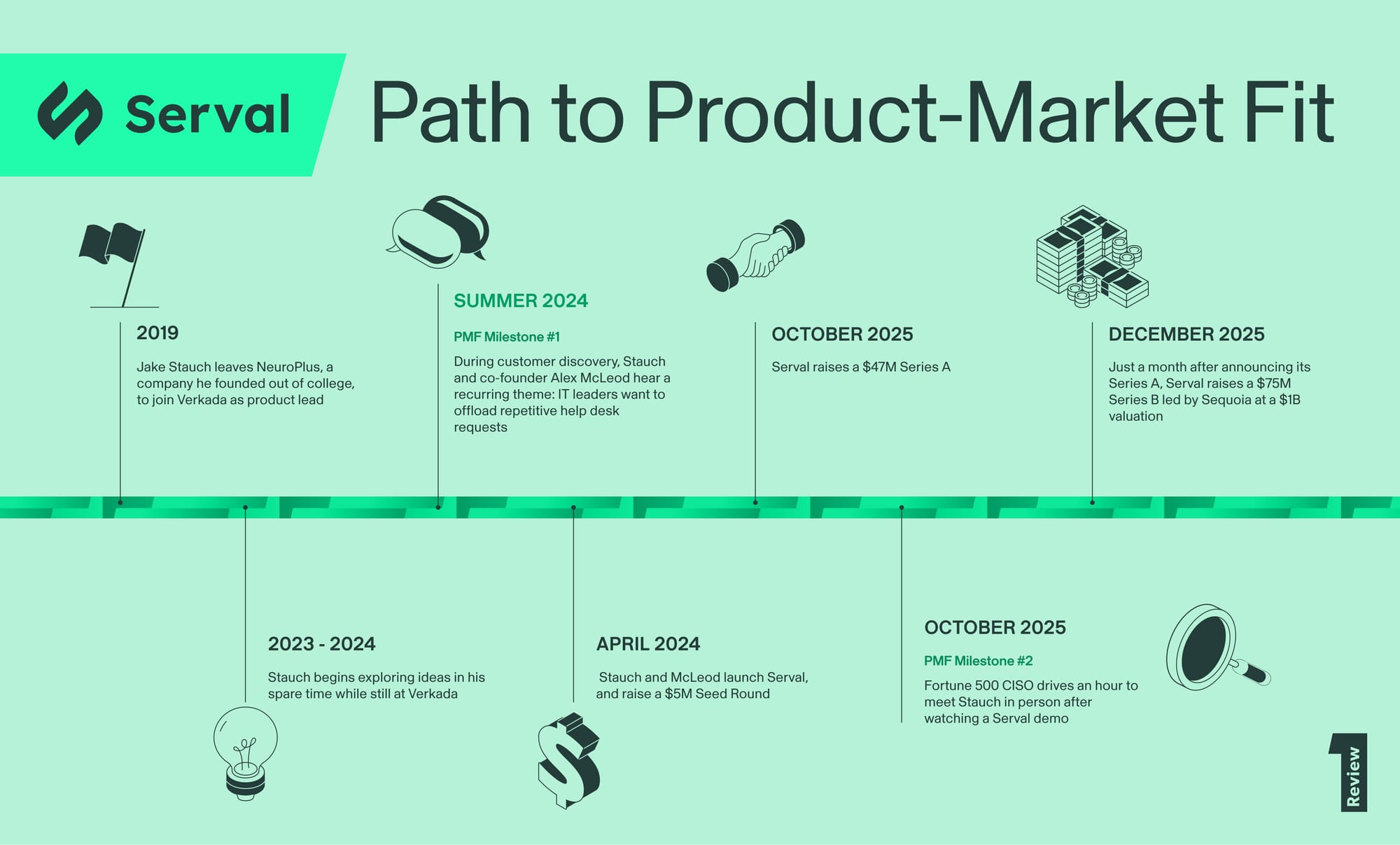
That insight was the seed for Serval, an AI platform for IT teams that, in just under two years after launching in April 2024, has reached a $1B valuation and nabbed customers like Notion, Clay and Vercel.
As partners to Stauch and the Serval team since the very beginning of that short and impressive timeline, we’ve seen how Stauch has applied what he learned from his time at Verkada to architect a remarkable business at every turn.
Here’s a peek under the hood, while Serval is still early in its breakout trajectory.
Sharpening platform instincts at Verkada
“Founding a company is the only thing I'd done before Verkada, and it's hopefully the only thing I'll do after Verkada,” Stauch says. He dropped out of Duke to found NeuroPlus, a video game headset that helped kids with ADHD improve their focus. Despite some initial success with parents looking for alternatives to medications, he says the company never really took off.
So in 2019, he joined Verkada as a product lead, eager to feel what it’s like to be at a startup with traction. He figured he could get what he needed in a year before starting another company.
It turned out to be fertile ground for a serial founder, and a masterclass in building out a platform, which in Verkada’s case is a cloud-based physical security platform. “I joined Verkada knowing I wanted to start a company. I thought I would stay there a year — I ended up staying there for five years because it was such a great place to be,” he says. “But the itch was always there.”Long before Stauch had the idea for Serval’s platform, these are three lessons he picked up while building Verkada.
Sell into existing budgets, but make sure your product is 10x better. Verkada’s business showed Stauch that to sell a platform, it’s a lot easier to build a Trojan horse of new capabilities — packaged into a product that buyers already have a well-defined budget to purchase.
The existing category for Verkada is security cameras, which enterprises already have budgets for. Anchoring to that category allowed Verkada to bundle in AI capabilities and video management into a full platform.
“I launched a lot of different products at Verkada, and I got to feel the difference between launching a product into a category where people were actively spending money, versus a category where no one had ever spent money on this thing before,” says Stauch. “There's something really powerful about building a better product in a category where people buy that product and want that product. Verkada owned the entire platform, so it was really cool to be able to sell a better camera to people that were going to buy cameras. And by nature of selling cameras, you could also sell AI capabilities and video management software. But you did that by selling cameras, not necessarily selling video software or selling AI.”
But playing into an existing category, Stauch learned, means you need to clear a high quality bar. “The experience has to be 10 times better. It has to be undeniable. It can't just be a little bit better, because people build their businesses around these systems. They're not going to put up that investment and go through a change management process unless the ROI is obvious from the moment they see the new version,” says Stauch.
Enterprise buyers are still real world consumers. Stauch witnessed the power of the 10X better product in action with Verkada’s demos. While showing a prospect how the Verkada camera works, a sales rep would send a live link of the camera footage to the customer on the demo call. “It sounds basic, but this capability had never existed in any of these on-prem camera systems. Getting a quick text message so you can pull up the camera feed — that blows people's minds.”
Stauch learned that even in the world of enterprise software, IT leaders are just like any one of us. They want to feel wowed by the tech they’re buying.
“At Verkada I was constantly reminded that enterprise buyers are also consumers. They use these very unsophisticated, very complex systems at work all day, but then they go home and use Nest cameras and Ring cameras,” he says. “So they’d start to ask why they don't have this same capability at the office, where they go 20 years in the past to use ancient technology just because they’re at work instead of at home.”
When buyers see something in their enterprise that starts to look like what they expect at home, that's when it starts to click for them how much better the experience can be.
Build the hardest part first. Verkada succeeded in building a platform by betting that competitors couldn’t catch up with the company’s ability to roll out complex hardware. Instead of tacking software onto existing cameras, Verkada manufactures and installs its own devices.
“Building hardware first is such a big barrier before you can actually get traction, but it's the better long-term solution,” he says. “Verkada gave me this confidence to actually seek out the things that are hard for other people to do that unlock a lot of customer value. Then once you've built them, it's so much harder for somebody to come in after you and build those same things because you decided to go hard early.” In addition to building its own hardware, Verkada also chose the hard route by adding products early to build out the platform. “Going multi-product is daunting. You've got a camera business that's going really well. So why mess everything up by going into access control, sensors, alarms and visitor management? We knew it would be hard to build every product to be best-in-class, but it was worth it,” says Stauch.
After a five-year run at Verkada, Stauch was ready to return to his founder roots.
The customer discovery breakthrough
In April 2024, Stauch put in his notice at Verkada and teamed up with his long-time co-worker, engineering director Alex McLeod, to start exploring ideas. They knew they didn’t want to compete with Verkada, but wanted to build on their combined experience in the IT market.
The duo were determined to run the discovery process until they could identify patterns in what potential customers wanted — however long it took. “Alex and I were both founders before Verkada. We were at companies that didn't really find crazy product-market fit, so we had deep skepticism. We needed to hear a lot of good things before we thought there was any chance that this business would work out,” says Stauch.
So they started by chatting with IT buyers, who comprised much of Verkada’s customer roster. But the challenge with this crowd, as the co-founders soon found out, is that they’re a unique combination of being both well-served by the software industry and highly-capable problem-solvers.
“The IT buyer in particular really prides themselves on figuring things out. And so they don't think about a lot of this process as being problematic because they figured it out, it works and it's quite effective,” says Stauch. “And it works, because they’re at organizations where everyone has access to the internet or the software they need.”
That’s when Stauch realized that relying on the classic “What’s your biggest pain point?” discovery question wasn’t helping the co-founders uncover the insights they sought. When Stauch started leading with, “What work would you offload?” the conversation shifted from what IT leaders couldn’t solve (they couldn’t think of anything) to what they simply didn’t like doing.
“When you frame the question as, ‘Hey, if you had somebody else here to help you, what’s the work that you'd give them?’ That's a nonjudgmental way of asking for pain points because you're saying, ‘What would you push over to this new person?’” says Stauch. “That way, they can be much more free to say, ‘I don't like to do these things or I am doing a lot of this and I think somebody else could do it for me instead.’ It allows them to have more of a neutral perspective instead of saying, ‘This is problematic or this is painful.’”
That led Stauch and McLeod to focus on automations for IT tickets and help desk requests, which they found surprising — given the abundance of automation tools already at IT leaders’ disposal. “There are tons of workflow builders and cool automation tools out there. This feels like such a solved problem. Yet when you talk to IT, they aren’t really using them. Something is not solved,” says Stauch.
So they asked a follow-up question: Why aren’t you using these automation tools? “We found out there’s a lot of friction involved in building these automations. The tools work, but it takes an investment for an often unclear ROI. The core insight we took from these conversations was that automation doesn’t actually work for IT unless it’s faster to automate something forever than to do it manually once,” he says.
Once Stauch and McLeod got enough nods in response to this IT automation idea, they set out to build it.
Building out the platform
Inspired by Verkada’s platform approach, Stauch and McLeod thought through what a platform might look like for IT automation.
“We started by tackling the thing that we were most unsure about first: Can we actually build a system that makes it faster to automate something forever than do it manually once?” says Stauch. “The way to do that, we thought, is a vibe coding platform for IT. Users have to be able to describe in natural language what they want to automate, and on the other side of that, you get an automation that works end to end.”
But the early product development process wasn’t an immediate success. Stauch and McLeod put their V1 automation builder in front of a few customers, who didn't really know what to do with it. But the pair were confident enough in building out the full platform to not be deterred by some initial customer confusion.
“It would've been very easy to start with an IT ticketing system that has a much better UX than Jira and ServiceNow. But we didn't think that was going to be the difference maker. We knew an automation builder and with a ticketing system woven in would be really, really powerful. So we pushed through the early skepticism and just kept building and iterating. Then as the platform started to emerge around it, the conversations with customers started to shift and they started to understand how the pieces fit together.”
They built out these products in quick succession:
- Ticketing system
- Workflow builder
- Access management system
Building out the full platform early required patience. It took a full year before customers began to see the value, says Stauch — when all the individual products were mature enough to make the platform cohesive. “It wasn’t until we’d really built out all the products individually that people said, ‘Oh, I see where this is going, and I see that once you add X, Y and Z, this becomes a really powerful platform.’”
Even after facing middling feedback, Stauch held onto conviction in the platform approach by reminding himself how massive the market opportunity is. “No matter how bad of a week I'd have, with a couple customer conversations in a row where they didn't really get it, I just kept coming back to the fact that these products exist in the market and they make a lot of money. People spend a lot of money on ServiceNow and IT ticketing. We thought deep in our bones that we could build a better version.”
Once the platform came together, Stauch found Serval’s answer to Verkada’s camera demo: Showing prospects the workflow builder. “In our demos, there’s this very tangibly different reaction to everything we show before the workflow builder, and then after,” he says. “Before, people are bored. They’ve seen a version of everything we’re showing them. Then comes the workflow builder. You can describe a complex IT automation, like an onboarding workflow, and all the steps: add the user to Google, take a web hook in from Rippling, message their manager on Slack. Then you hit Enter, and the workflow generates before your eyes.” From there, says Stauch, prospects start to imagine everything else they can do with the platform, like password resets or reporting workflows.
Winning in an incumbent market
As Serval hit the market, it faced a steep hurdle: going up against ServiceNow, the hundred-billion dollar, decades-old incumbent.
In the world of startup sales, a lot of the advice can be boiled down to “pick a lane”: Stick with a narrow ICP, sell to mid-market then gradually move upmarket. Stauch has found early sales traction in this tricky category by resisting this convention, choosing a “both” model instead: Selling to mid-market and enterprise, stirring adoption through top-down and bottoms-up motions.
Here’s how Stauch is building the GTM engine to battle the incumbent.
Carving out two ICPs: Mid-market and enterprise
The reason Serval has been able to win both mid-market and enterprise customers, says Stauch, is that the two profiles don’t actually look all that different in this category.
“We thought we’d start in the low side of mid-market and stick around there for a long time, and gradually we’d move upmarket. But what we started to see is that the problems we’re solving in the mid-market weren’t any different from what the large enterprises faced,” he says. “These enterprises that were historically late to the party have started to feel more pressure from the board and C-suite to start implementing, or at least exploring, AI solutions.”
Stauch says product-decision making actually helped make Serval fit for the enterprise. “We built this product that is built around a flexible code-based workflow engine that can then flex into large enterprises quite easily,” he says.
Top to bottom: Courting CISOs and IT support staff
To sell into the enterprise, Serval has made inroads with every rung on the IT org chart.
“As you sell into larger organizations, the actual folks doing the implementation can be a very large team. The chances that they’re completely excited about this new tool are close to zero,” he says. “So you need somebody with a drum beat who says, ‘We’re doing this because I believe in the vision.’ So you need the leader on board.” That hinges on a great demo. Stauch shares how Serval’s consumer-grade demo recently won him an in with a big exec. “I did a demo recently for the CISO of a Fortune 50 company. After he saw it, he asked me, ‘Where are you right now? I'm going to drive to see you. I'll be there in an hour because I wanna meet you.’”
But turning rank-and-file IT employees into champions is just as important. A way to do that, Stauch has found, is to help them look good — instead of just replacing the workflows they implemented. “One of the coolest things we’ve done that we didn’t anticipate is we turn IT into builders. They get to be creative and build cool stuff with the workflow builders. There’s some parallels with what Clay’s done with the go-to-market engineer,” he says. That sparks a chain reaction: They create workflows that they can share with other folks across the org.
Stauch and the team have even been surprised by some of the workflows lower-level IT users have cooked up. “They’ll tell us, ‘Hey, we built this workflow that does X, Y and Z.’ And we say, No, that's not possible. You're probably confused about how it works. And they'll show it to us, and it works. It's so cool to see someone do something with your product that you didn't think was possible before.”
People find ways to do cool things with a product, and that’s something we’ve leaned into to combine top-down pressure from the executives with an upswell of support from the folks that are actually implementing the tool.
The path ahead: Balancing first principles thinking with respect for how things were
Serval is still early in its journey, but the team’s progress so far has been remarkable: Serval raised a $75M Series B just months after closing its Series A in October 2025, and has snapped up dozens of customers from the incumbent. "In just 90 days since their Series A, Serval has grown revenue by 500%, tripled headcount, and raised another round at a $1B valuation. This team is moving at a pace I’ve rarely seen in all my years at First Round Capital,” says First Round Partner Bill Trenchard, who led Serval’s seed round.
Stauch’s outlook on Serval’s future is a hybrid of the two perspectives of Verkada’s leaders: CEO Filip Kaliszan and Chairman Hans Robertson: Understand why the category exists, but push where you can take it.
“Hans was very interested in looking at these existing, established markets and building a better version of products for markets that already existed. Filip often looked at a lot of these problems from first principles, thinking about how a new product might look different from what's come before. I often have both of these perspectives in my head — weighing both is more valuable than adopting either one wholesale,” he says.
“Serval is a combination of these two ideas: build a better ITSM where there's a massive market and a lot of customers that buy ITSM, and build something that's never existed before, which are AI agents that build IT automations and answer help desk requests.”
To win in an existing category, yes, you want to build something better. But you also have to ask why this category exists. The history can tell you something — it's a signal, and not always something you should just ignore so you can build something from scratch.