
In March 2012, Cameron Adams returned to Sydney from San Francisco at an uncertain moment. The Google alum had just come back from a fundraising trip for Fluent, the email startup he’d co-founded, without securing the backing he’d hoped for. He also had a newborn at home.
“We spent two months traipsing up and down Sand Hill Road and all over the Bay Area. We thought we would come back with a novelty-sized check of $2 million. Didn’t pan out that way."
He’d left his role as a user interface designer at Google to give the startup his full attention, a decision that left him taking stock of what came next. That’s when Lars Rasmussen, the co-founder of Google Maps and Adams’s former boss at Google, came to him with a serendipitous suggestion, encouraging Adams to meet a young entrepreneur he’d recently been introduced to: Melanie Perkins. Perkins, with her partner Cliff Obrecht, had built an online yearbook business called Fusion Books, which was pulling in $2-3 million a year. But they had their eyes on a much bigger prize. If students could easily design and publish their own yearbooks online with zero design skills, it stood to reason that with the right tools, anyone should be able to design anything.
Adams met with Perkins, but he was hesitant to dive into another early-stage startup, given he was still a little bruised from Fluent’s disappointing reception in Silicon Valley. He politely declined to take the conversation any further. But the idea of bringing design to everyone continued to brew in the back of his mind. After another attempt to fundraise for Fluent went nowhere, it occurred to Adams that perhaps he should revisit Obrecht and Perkins’s pitch. From there, things moved rapidly. After one in-person meeting and a couple of Skype calls, Adams was in. Just over a decade later, Canva is valued at $42 billion, is used by more than 260 million people in 190 countries each month and has revolutionized access to graphic design.
In this conversation, Adams reflects on Canva's remarkable path from scrappy startup to one of the most valuable private tech companies globally, from that lightning-fast founding courtship, to an “anticlimactic” launch day. He shares the key decisions that helped the company find product-market fit with early evangelists who would be crucial for Canva to scale, how a late funding scare pushed them to operate profitably for eight years running, and much, much more. Let’s get into it.
From a lightning-fast courtship to a humbling launch day
Co-founder matching can sometimes feel like speed dating, but Adams’s quick decision to team up with Obrecht and Perkins was unusually fast by any measure. He committed to building Canva with the near-strangers after a single two-and-a-half-hour meeting, followed by a couple of follow up calls and emails. Adams partly credits this decisive action to the fact that he wholeheartedly believed in their vision, the designer in him understanding the potential. “I’ve always believed everyone is creative, they just need the right tools,” Adams says. “Being able to bring visual design to people who had never thought about tackling it before was compelling.”
But there was also something beyond logic — a gut instinct that said, leap in. “It was a rapid courting session,” he admits, “but when I met Mel and Cliff, we just clicked." There was also the fact that Lars Rasmussen had introduced them and vouched for him.
Adams attributes his sharp intuition to the self-knowledge he’d gained in the years leading up to meeting Obrecht and Perkins. At Google, and during the years he was trying to build Fluent, he’d learned a great deal about himself; his strengths and preferences, as well as what he needed in teammates as a balance. He recognized right away upon meeting his future Canva co-founders that the trio’s skill sets complemented one another. “Cliff was an amazing operator. He thought about hiring, revenue models and margins. Mel had a huge vision around how to bring teams together and rally the world behind this idea. We quickly wanted to get into building Canva.”
Luck and timing also played a role. Adams sees luck not as something passive, random, or beyond his control, but active. “You put yourself in a position of luck,” Adams says. “Luck came from reaching out to someone, working late nights on an idea and pushing it out there.”
If you sit in your room at home and never talk to anyone, nothing is going to happen.
Within a few months the newly minted co-founders had rented an office in Sydney and were building the first version of Canva. The early product work was scrappy and fast. “It was me and Mel sitting in this cavernous, empty office, jamming on ideas, sketching both physically and on the screen, and then quickly getting those ideas into prototypes,” Adams recalls. “It was really important for us to feel the product and know it was the right product.”
As they embarked on a relentless prototyping run, Adams and Obrecht decided they would follow the Double Diamond design thinking process. “You go wide, you come back in, and you go out wide again as you get user response, and then zero in on your final product,” Adams explains. This phase lasted around three months, until they felt ready to hire an engineering team to start building out the product with an eye to ship. Adams’ hybrid skills, equal parts designer and coder, made it possible to iterate fast. “We could sketch something and in a few hours use it on a computer,” Adams says, crediting this speed as a crucial early building block (this was, of course, long before AI made rapid prototyping a standard part of every designer’s toolkit). “I find it easy to think about a design idea, sketch it, and get it into code, which is a really important step when you're building a product,” he says. “It isn't until you've tried something interactive for yourself, and then put it in someone's hands, that you know how it's going to behave.” Once Adams and Perkins did bring on an engineering team, progress sped up further. “The engineers started laying down the architecture, thinking about the data we'd need to store, how we'd store images on the front end, how we'd do all the manipulation and keep it stable,” Adams says.
Six months out from launch, Canva’s ICP was still intentionally broad. “We wanted to bring design to the entire world. When you're trying to do that, you can't pigeonhole yourself.” But a few months before launch, they recognized the need to start homing in on a target persona. “If you push out a product and say, ‘This is for everyone,’ it's really hard to get people interested,” he says. So, they identified people who need to create professional-looking designs, such as small business owners, marketers, teachers, and students, but lacked design experience and/or access to expensive software like Adobe Creative Suite. Adams and his co-founders wanted to reduce the time, cost, and hassle involved in making flyers, presentations and other small design projects for this large swathe of people. Still relatively broad, but at least more narrow than “everyone.”
They began initial rounds of user testing, a mix of in-person focus groups and an online service called usertesting.com that connected them remotely with people willing to try out the product and provide feedback. Adams and Perkins quickly noticed something: a lot of people opened Canva and promptly froze. “They were like, ‘I'm not a designer. I'm scared of screwing everything up.’” Canva was a product intended to make anyone feel they could be a designer, but in an ironic twist, imposter syndrome made them feel as though they shouldn’t even try.
A relatively simple solution emerged. Adams and his co-founders came up with the idea to produce a 23-second onboarding video that showed what was possible in Canva (moving images, resizing text, layering shapes), which would play before the user was dropped into a guided exercise. The exercise prompted the user to drag a monkey onto the page, put a hat on it, change the color of the hat and search for a slice of pizza. It was silly. It worked.
What Adams remembers most of this period, in the last few months before Canva launched, was this excitement in the air — as well as a fair amount of stress. “As a founder, you're not just focusing on the product. You're also thinking about the company, the team, PR and press, how you pay people, the business model. It was frantic, trying to juggle all those things, while still placing a premium on the product and making sure that we're delivering an amazing experience. But incredibly exciting.” Adding to the pressure was the fear a competitor would launch first, which was amplified by several investors who urged the founders to ship earlier than they were comfortable, pressure they resisted. Adams says it was important to them to strike the right balance of quality and speed. “We sweated the details, made sure it was something that we were proud of. But we knew we had a few bugs and flaws.”
In August 2013, Canva officially went live to a waiting list of more than 15,000 people. This time was a strange mix of both dramatic and anticlimactic, for Adams even more than the rest of the team. Two days before launch, he was hit by a car while cycling and knocked unconscious. Adams was rushed to hospital, where he received stitches on his face.
“I was back at work the next day,” he says.
Shaken and sore, but determined the team would hit the milestone they’d been working toward for months, Adams was there in the office to hit the go live button. Momentous as it was, there had been so much build up that it felt, in a way, anticlimactic. A Google Analytics dashboard mounted on the wall showed not a tidal wave of tens of thousands of users flooding the site to try the product, but instead a mere trickle.
“After about 30 seconds, one person visited the site. Two minutes later, another one. Five minutes later, three more. Then it just went quiet,” he says. “We realized there wasn't going to be a flood of users.”
It was a humbling experience, one that taught Adams not to put too much emphasis on future launches. “If you're starting at zero and adding a couple of users every day, and then a thousand a week, and then 50,000 a month, it stacks up.” The real work, he says, comes after launch. “Turn up every day and plug away, make the product, engage with your customers, be firm on the vision that you want to create, and keep heading towards that,” he advises.
When you're looking at a journey of 10 or 20 years, the launch is probably the least important thing.
Social media managers: the early evangelists who fueled Canva’s first wave of growth
Despite the “anticlimactic” launch, Canva quickly found traction. Around 500 people came to the website that first day. By the end of the week, that figure had grown to more than 5,000. By the end of the first month, 20,000. “It was instantly valuable,” Adams says. “From the early days, retention was pretty high. Around half of the early site visitors turned into ravenous users.”
Adams and his co-founders stayed focused on understanding exactly how early users interacted with the product — what confused them, what delighted them, and where the experience still needed smoothing out. “The first year, we built out the product and got more features in there to make it a more solid platform for customers who were turning up to have a great experience.”
With more user feedback sessions, a specific cohort of people who were connecting with Canva the most began to emerge: social media managers. At the time it was still a relatively new profession, but growing rapidly as the internet entered a new, hyper-visual era following the boom of Pinterest and Instagram. “They needed to create a lot of content, but they couldn't afford to pay a professional designer to do it,” he says. “They were time poor, running their own business, liaising with clients, and also needing to think about text, visuals and strategy. Canva was the perfect tool for them to be able to scale.”
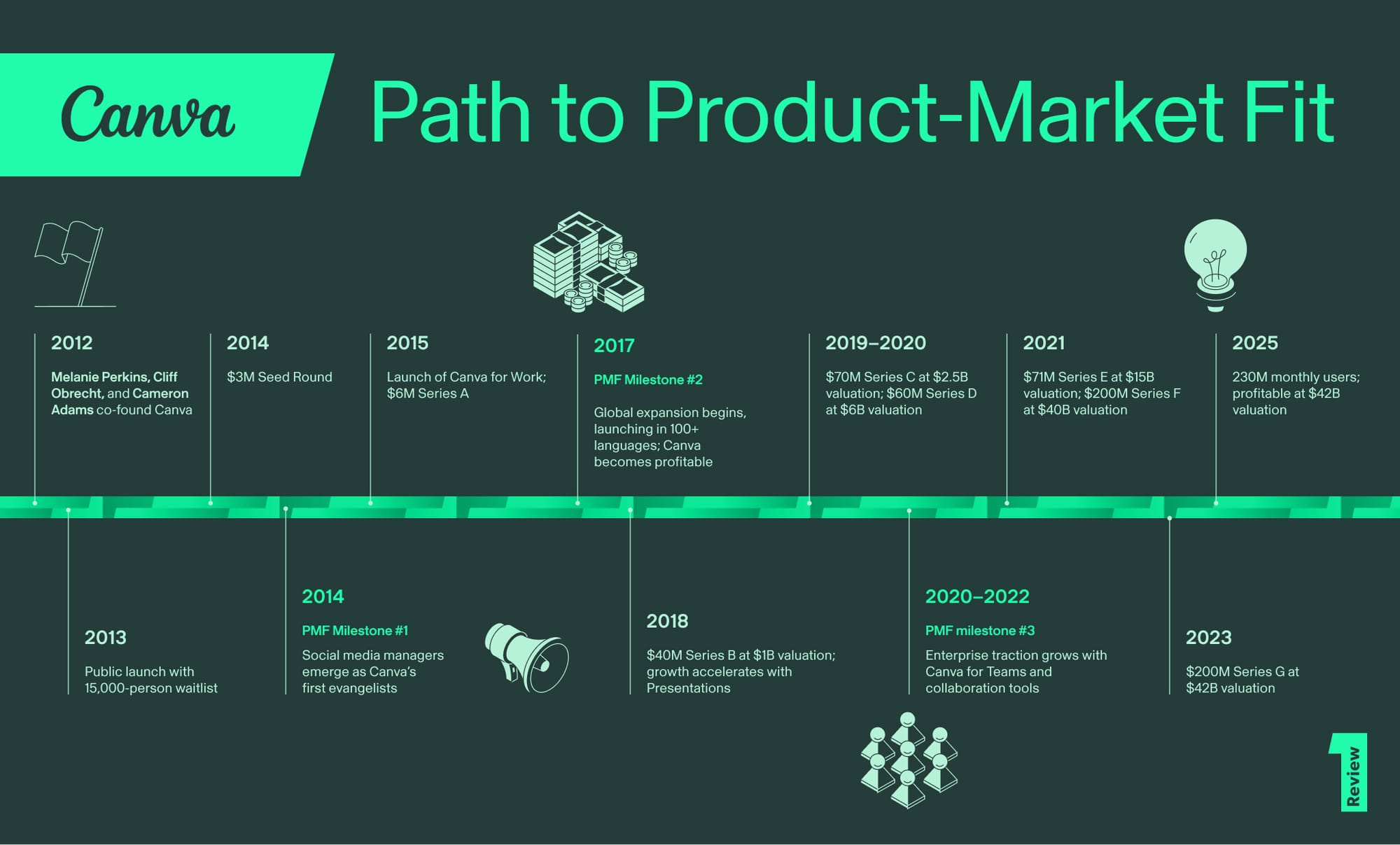
Canva’s drag-and-drop simplicity and free templates meant it quickly became an essential tool for this underserved audience. These early adopters were loud about their enthusiasm for the product, which had a powerful word-of-mouth effect. “They were naturally online, talking to their peers, sharing tips and tricks, showing what they’d made,” says Adams. “They became our first real evangelists.”
This created a feedback loop: the more content they made, the more others saw Canva in action, and the more signups grew. The team leaned into the momentum, refining templates, adding social-specific formats and shaping messaging around this community of fans. “They loved being on social media, telling people about the tools they were using, introducing Canva to others, giving tips and tricks. A great first customer to land on.”
Adams says tailoring the product experience to this group of zealous early users was a pivotal moment for Canva’s growth. “Being responsive to them, building them up as your advocates, making them feel like they're part of the team so they're really willing to talk about your product to other people — it’s incredibly important,” he says. “Other growth strategies can kick in after that. But having the community that loves your product because it's a quality product is one of the key ways that we build. Word of mouth in those early years was like gold for us. Still is.”
Even so, Adams insists that Canva’s broad appeal has also been central to its success.
“Our vision encompasses so much possibility. People can use it in such different ways. That's driven me for the last 13 years,” he says. “There's so much opportunity, so many unique and interesting problems we solve for different types of users, and that enables us to constantly be innovating. I don't think we could do that if we were just focusing on one small user group.”
More than a decade since launch, Adams and his co-founders still place a high importance on fostering community. Canva maintains a presence in online groups and forums that have grown organically around the product. “We share tips about what's coming up on the roadmap, respond to requests, make sure their bugs are filed.”
That's how we think about community: it’s more about the broader ecosystem than building specific tools that bring community together on the Canva platform.
They take a similar approach to managing user complaints and technical support requests. “Being able to convert someone who is frustrated with your product, have a great customer service interaction and turn them into a Canva fan — that creates another person who's willing to talk about Canva. Who will sit down at a bus stop next to someone and tell them about the product, show them their favorite design and win you another Canva user.”
The two levers that supercharged growth: SEO and localization
Over the next couple of years Canva started to unlock new parts of its growth engine. One of these was SEO. Adams admits that before they launched, he and his co-founders had only “vague ideas” about how SEO would drive growth for Canva. But that changed when they found a growth leader in Australia who reimagined the entire funnel. “It was about the whole flow of someone typing in a search, ending up on a Canva landing page, getting them into the product, and making that a really great experience.”
The SEO project involved mapping hundreds of search terms, then building tailored landing pages for each one, a pioneering example of programmatic SEO. The user would land on a page with information about what they were looking for — wedding invitations, birthday cards, marketing content for Instagram, business presentations — and in a click they were inside Canva, seeing how they could create it for themselves. “We gave them an easy entry point into the editor, and then we made it clear once they were in the Canva editor how they would achieve the job they’d set out to do,” Adams says. “We started seeing returns within three months. It scaled up over the next couple of years to become a massive driving engine for us. It’s still a massive source of traffic.”
In Adams’s mind, another lever was equally as important: international markets. Since they were based in Australia, which has a population of less than 30 million people, Canva had no choice but to think globally if they wanted to scale. “You're never going to create a scaled online company just thinking about the Australian market.”
Three years after launch they began to execute in earnest on a global strategy that focused on localizing for key markets. “We launched eight languages that year. The following year, we launched in a hundred languages.” The growth was explosive. “Brazil, Mexico, Indonesia, India, massive markets, a lot of non-English speakers — it has totally reshaped what the product of Canva is, how we surface content to people, how we give them a great experience wherever they are in the world,” Adams says. “It’s intensely localized. It’s not just in their language. It also has all the right content; it speaks to their cultural norms.”
Hard lessons: A code editor rewrite, a wobbly enterprise launch and a chaotic funding round
One of Canva’s toughest early lessons arrived when the team realized they had to rewrite the entire editor codebase. This meant that for two years they were unable to launch any new features. The only alternative would have been to do the work in parallel, and then bring the old and new versions together, which Adams believes would have pushed out the timeline too far, and created unnecessarily complex launch headaches. “It was ultimately the right call, because it set us up for real-time collaboration, truly scaled teams, hundreds of people using designs together, velocity of products, a better tech stack that enabled us to scale to hundreds of millions of people,” he says, “but it was a struggle to get through.”
On the business side, things were much more straightforward, at least at first. For the first two years, revenue came from a simple model: users could buy stock images and other content for $1 each. “Part of designing is getting access to the ingredients for a design, whether that's a photograph, a font or a video,” Adams says. “It was extremely expensive to do that. We enabled you to design and grab the content in the same tool — and do so easily and cheaply.”
The model was working; they were scaling, and seeing approximately 30% month-on-month revenue growth. But as Canva grew, Adams and his team began to notice a particular group of users that was pushing the product further than the average small business owner or social media manager. These users wanted more out of the product: more control over their brand, more consistency across designs, and a way to collaborate with the people they worked with.
There was also data showing that Canva sometimes had upwards of 5,000 users within one company. They knew it would make sense for a large company to take a more cohesive (and affordable) approach to incorporating the product into their tech stacks. So, Canva created a subscription tier specifically for enterprise. “We made some vague promises that it would be better for large teams and brand consistency. It got a little bit of traction, but it wasn't very successful.” Adams says this was because they neglected to target the right decision makers in the enterprise organizations, those who could advocate for the product and ultimately secure contract sign-off. “Finding the right decision-maker to champion it is a different play to the grassroots adoption we were used to. It required us to rethink what we were offering.”
As with those early users who got stage fright at the blank canvas, forcing the team to problem-solve, quickly, the team used Canva For Work’s lukewarm launch as an opportunity to learn, understand their users more deeply and improve their offering. “We’ve since learned a lot more about the enterprise space, what scaled teams need from their visual content, how they want to control their brand, and how they want to interact with teams across the organization.”
Canva Enterprise launched in May 2024. “The reception to that has been far more successful,” Adams is happy to say. FedEx, the New York Stock Exchange, and Amazon are among their customers.
Yet another hard lesson that still makes Adams sweat a little to recall is their third funding round, in 2018. A bullish investor valued Canva at $100M and wanted to put in tens of millions. But, at the last minute, they decided to value the company at half of what they’d discussed. The co-founders scrambled, and ultimately pulled together a totally different round of funding that did not include that investor. They learned a powerful lesson in the process. “We decided we didn’t want to be beholden to any investor. We didn’t want to be in that position again,” he says. “Since then, we've put a premium on being a profitable company, making sure we can run the company without having to put our hand out.”
They’ve since been profitable for eight years straight.
The power of being a first mover and creating a new category
“Canva has grown from zero to 260 million people that use it every single month. It’s been a crazy, wild ride, one I didn’t sign up for in the first days,” Adams says. “We put Canva out into the world with huge hope and promise. It's been amazing to see the world respond.”
From Adams’s point of view, Canva owes much of its success — before evangelizing early users, creating a programmatic SEO flywheel or launching in international markets — to being a first mover in the category. “We essentially created this category of democratized visual design. Canva is still the foremost design platform that anyone can access anywhere in the world. The growth that we've experienced is a testament to our belief in the vision.”
Looking back on the “wild ride” of the past decade, one thing that stands out to Adams is how grateful he is that he and his-founders didn’t take no for an answer. And they were told no. A lot.
“I'm sure they're kicking themselves now,” he says. His advice for other founders going through the hard knocks of rejection? Get used to the fact that you see a different view of the world from other people. “Have confidence in your vision and recognize that some people aren't early adopters,” he says. Find the people who do share your vision, who do get excited about what you're building, and drill into them. You can win the rest of the world over time.
In the early days, just focus on the positive, optimistic users who really will lean in, and don't worry about converting the naysayers.
For Adams, there was no single “aha” moment when Canva’s success became blindingly, undeniably obvious. But one early email stands out. “It was from an orphanage in South America. They wrote to thank us — they were using Canva to create newsletters that helped children find adoptive families.” That note crystallized what Canva was really about at its core. “It was someone I didn’t know, in a country I’d never been to, using Canva to make an impact in their community. That’s when I realized — this is bigger than us. This can reach anyone.”