
I’ll never forget back when I was a founder + CEO, sitting at a dinner with some founder friends a few weeks after closing my Series A. Our first board meeting with our new investor from General Catalyst was coming up, and I had been obsessing over the agenda, making sure I had every number ready. Another founder asked, “How’s the board deck coming?” I said, “What deck?!”—and immediately panicked.
First-time founders tend to make one of two mistakes: they overprepare for the performance or underprepare for the conversation. I somehow managed to do both.
Now that I’m a Partner at First Round, many first-time founders in my portfolio ask how to prepare for their first board meeting – and often ask for feedback afterward. The advice is always somewhat company-specific, but the same principles come up again and again. Here is the practical guide I wish I had.
Stepping back: your goals
I once heard a founder describe all board meetings as “dog-and-pony shows.” After attending 100+ board meetings, I can say: bad ones are. Good ones are not.
A bad board meeting is when the founders just recite updates that should have been in the pre-read, or spend time on topics that are not critical to the business.
A good board meeting is 2-4 substantive conversations about the issues that matter most. You (the founder) should aim to give directors an honest view of the company and use their context and pattern recognition to pressure-test your thinking. It also can serve as a nice artificial deadline / ‘forcing function’ for your team around some accomplishment or launch.
For investors, a great board meeting can result in them getting better clarity on your business, both so they can be more helpful to you (after all, the purpose of a board meeting is to serve the company) and so that they can have a stronger POV on the state of your business.
If the meeting is successful, you (the founder) should leave a board meeting with a few questions, useful pieces of advice, some new perspectives or ideas, or concrete follow-ups. You probably will not have your mind blown. But you should think differently about at least one important issue, assuming the meeting was good. (And, assuming you think your board is competent, I’d argue it’s your responsibility to ensure the meeting is not a waste of your time.)
I’ve seen countless examples of founders having meaningful “a-ha” moments in board meetings – and my goal for this article is to help improve your chances of having that happen.
Rule #1: No big surprises
This is one of the most important things founders can get wrong. If a key exec is leaving, a major customer churned, you missed your quarterly goal by a lot, or something significant is happening, your board should hear it from you directly before the meeting, not during it. Board meetings are for discussion and decisions, not for dropping news they might need time to process.
Effective pre-meeting materials:
Aim to send out a pre-read ahead of any board meeting at least 48 hours in advance, assuming you want people to have time to read it ahead of time (hint: you do). This pre-read is typically in the form of a memo (a google doc, usually with comment access) or slides.
So: memo or slides? My suggestion: do whichever feels more comfortable to you.
- Some founders (like I was) think in slides. Just make sure that if you’re sending a slide deck (and not a memo), that they can stand on their own without narration or a voiceover.
- Other founders think in memos (i.e. they just want to talk through what happened). Just avoid making the memo too verbose.
One useful way to open a pre-read is with a simple company report card. Give yourself a grade in each major function (example functions can include: Sales, Customer Success, Marketing, Product and Engineering, People, and Finance – but you should customize those to your business). Briefly explain the quarter’s wins, misses, and priorities. The point is not the letter grade itself; it is to force an honest, concise assessment before getting into the details. This report card can also serve to show investors “what we said we did” vs. “what we did” in the quarter.
Here is a format you can copy or adapt:
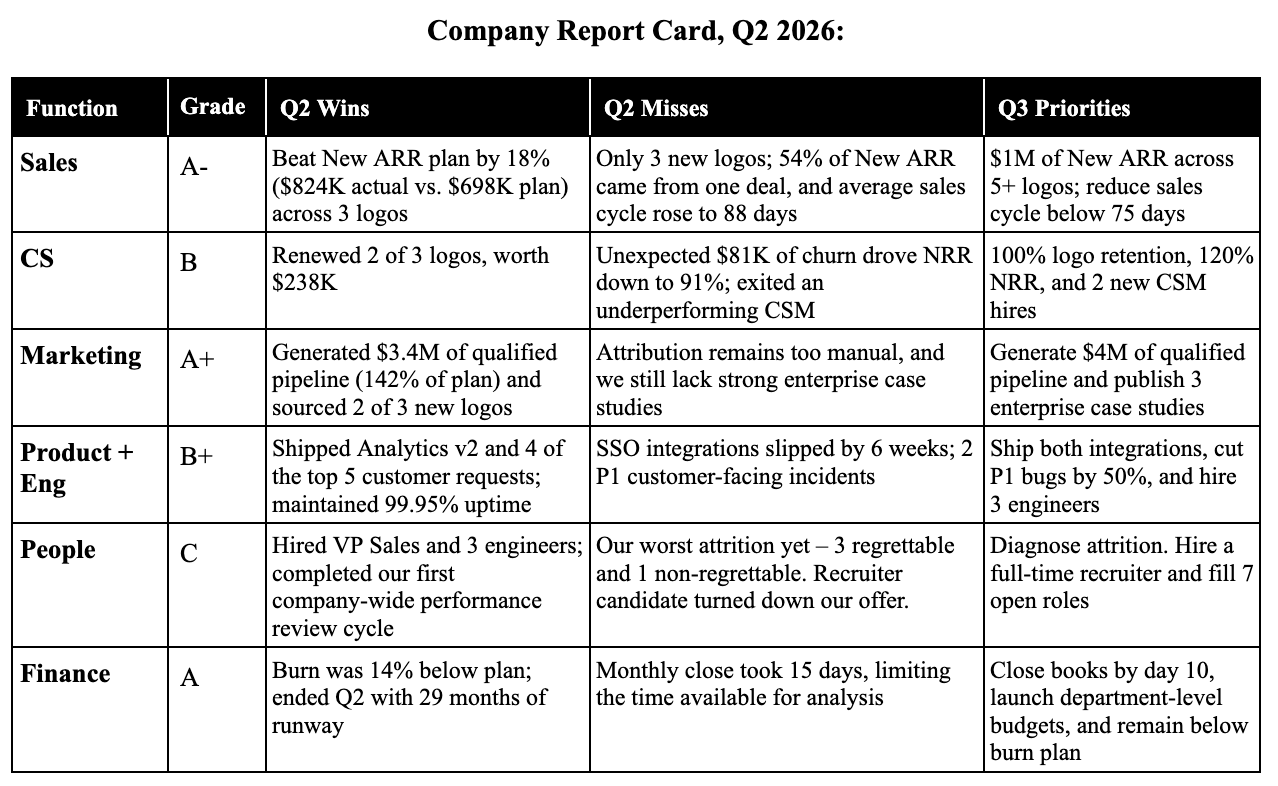
Be direct about what is and isn’t working. Don’t sugarcoat. A board will notice if every function receives strong grades despite obvious problems. But do not manufacture failing grades just to prove you are ambitious. The board should also understand what the team accomplished.
After the report card, you’ll likely want to include two other types of high level commentary:
- First, the “forest through the trees” CEO view of your business. Stepping back, as CEO, anything you think is important to note? What do you see that the functional updates do not capture? How is team or customer sentiment? Where has your conviction strengthened or weakened?
- Next, the market view. What has changed in buyer behavior, the competitive landscape, or the broader market? Your board likely knows the category less deeply than you do; teach them what you are learning.
After the report card and your high-level thoughts, you’ll dive into the more detailed functional updates. This should cover what notable things happened over the past quarter in each function (this doesn’t mean they need to hear everything your team did), how it compared to your plan, why it happened, and what changes next quarter. Do your best to have the memo be comprehensive yet not too detailed that it becomes too long or unimportant.
Note: Many first-time founders I work with ask me for an example memo or deck ahead of their first meeting. Most Seed or Series A leads have a few sanitized examples, so just ask yours. Hopefully it can inspire you or bring this article to life.
Agenda Topics for the Board Meeting
In the meeting itself, you’ll want to avoid regurgitating your entire pre-read. Instead, the board meeting will often be focused on 2-4 specific topics, which you’ll list at the end of the pre-read so folks know what to expect. I say “2-4” because it depends on how meaty the topics are, and how long your board meeting is.
Example topics could be: churn, the future of the sales organization, product stickiness, hiring, M&A, product direction, etc. It’ll be most helpful to choose topics where the people in the room can actually help. For example, an investor who is great on GTM may not be the right person to advise on model architecture, and vice versa.
Label each agenda item as an Update, Discussion, or Decision so everyone knows the intended outcome. Depending on the topic, you may want to give more or less context ahead of time. That said, the bigger the decision / discussion (like strategic interest in the company or a big shift in strategy), it’s often best for founders to do a lot of work to context load the board ahead of time with reading material (prepared far enough in advance) so they have a good understanding of what's happening on the ground.
By the way - these discussions can get really intense, so make sure one of the founders is on top of keeping track of time during the meeting. You don’t want a situation where you find yourself going down a rabbit hole that isn’t helpful, and missing other topics that were much more important.
Sending out the board memo
When you send the materials (ideally 48 hours in advance!), you can invite board members to leave questions and comments in a live/viewable format ahead of time, if you’d like. Often, founders will then answer factual clarifications in the document before the meeting, and will flag substantive threads for live discussion in the first 20-30 minutes of the board meeting (or as a newly added agenda item).
Ask your outside counsel several days before you plan to circulate materials for any prior minutes, option-grant approvals, resolutions, or other documents that need board action. They should send you documents which you can then send out alongside the pre-read.
Materials for the board meeting itself
As I said earlier, don’t fall into the trap of just reciting your pre-read during the board meeting. That would certainly be a “dog and pony show.”
Assuming you spend the first 2-3 minutes getting verbal approvals for your legal items, then the next 20-30 minutes answering any questions from the pre-read documents, founders will typically pull up the agenda topics and go through them, one by one. Often, at least one of the discussion topics will be about one of your “misses” from the ‘report card’ you included in your pre-read.
In most cases, I’ve seen founders bring slides to accompany each discussion topic, where the slides have the relevant information investors may find helpful during the discussion topics. For each discussion topic, you can include:
- The question or decision
- The relevant context and data
- Your current leaning/recommendation (if you have one)
- Bring a recommendation even when your confidence is low. “Thoughts?” is rarely a useful board ask. (For example, Too vague: “How should we improve retention?”... Better: “NRR fell to 91% after some unexpected churn. We believe weak onboarding is the primary issue. Here’s our plan. What are your reactions to this plan? What companies have you seen have great onboarding, and why was the onboarding so great? etc.”)
- The alternatives and trade-offs
- What you want from the board: advice, pressure-testing, introductions, or a formal decision
Aside from discussions and decisions, you may also have an update that you wanted to cover live. For example, some founders like to show product demos ahead of something going live.
Bringing Execs into the meeting
It’s very common for a founder to bring in a relevant leader into the board meeting either when the executive is new, or if there’s a topic you want them to be present for or lead. (For example, if you’re bringing them in when they’re new, it can be helpful to ask them to present for 10 minutes on what their early observations are – good and bad – now that they work at your company, and what their focus will be for the next 60-90 days.) This gives your leader nice board exposure, while also helping your investors begin to build a relationship with him/her. That said, don’t keep a large audience in the room for the entire meeting unless there is a reason, as it can make candid discussion harder.
As your company grows and adds multiple (3+) investors to the board, many companies will add two different exec sessions for the last 20-30 minutes of a meeting. First, they set aside 10-15 minutes with JUST the Founders and the board (no finance person, chief of staff, etc). This gives the board members and founders the opportunity to have candid discussions without anyone else from the company present. In the latter of the two sessions, the founders step out and the other board members have a candid discussion - after which, one of them provides feedback to the CEO. (Most of the time, there is nothing meaningful to discuss and these sessions are short. However, when a discussion is needed, the fact that these sessions have consistently been scheduled avoids the awkwardness of asking for one.)
Outside Corporate Counsel
The other person who should be in your board meetings is your external General Counsel (Gunderson, Cooley, Orrick, Lowenstein, or whoever you use). Not only will they typically join to ensure you get your approvals for prior minutes (after the first meeting) and/or for new option grants, but they also take “minutes” (i.e. high-level notes) during the board meeting. These minutes are intentionally broad, objective summaries of the topics discussed and decisions made… not a word-for-word record of the conversation.
You may be thinking: why do I need to pay my GC to take minutes? The fun answer is: most of the major startup law firms don’t charge you for this time.
The next question you may be wondering is: what goes into the ‘minutes’? Consider board minutes an official corporate record, not a transcript. Their purpose is to document that the board was informed, discussed the important issues, and made or approved relevant decisions. An overly detailed record can preserve sensitive or privileged information unnecessarily, and create issues with a future investor, acquirer, regulator, or plaintiff’s lawyer (future investors and acquirers often ask for all prior board minutes). The goal is therefore to be accurate but concise.
Building Board Rapport
Board dinners (or lunches) can be a nice option, especially if you have multiple board members or when people are traveling in for the meeting. Most commonly, founders will schedule these the night before a board meeting, and will often keep it mostly social or will cover topics not in the board agenda in order to avoid conducting the board meeting twice. A meal afterward can also work, particularly for informal follow-up. Just try to avoid letting the meal become the place where formal decisions are made.
After the board meeting - following up and getting feedback
In addition to following up with certain board members about action items they may have signed up to help with, it’s common for a founder to ask one trusted director or board observer for candid feedback on the board meeting (especially if you’ve never attended board meetings before). I also like this framing, which a founder asked one of my partners: “If you were to send a report of the meeting to your firm's partners, what would you write"?
Switching it up over time
As you heard me say at the beginning, there isn’t one right way to have a board meeting. Your board meetings will – and should – change (a lot!) over time, and based on the needs of the business. As your company grows and its needs change, I encourage you to think about different ways you can shift the meeting structure to better serve your company.
Good luck!
A board meeting is not a quarterly exam. It is a forcing function for clear thinking and a chance to put your board to work. The founders who get the most from their boards show the truth, bring a point of view, and ask for help on the few things that matter most. I hope the above will be helpful as you prepare for your upcoming board meeting – and good luck!
P.S. There is an awesome First Round Review article that is a little more high level about board meetings, which includes some direct quotes from awesome executives out there. While you may or may not resonate with the ideas shared by those executives, you can certainly get some inspiration from reading it, so I recommend checking that out ahead of your first meeting!
Thank you to the several founders and investors who I sent this article to, who gave me helpful feedback. I appreciate you!